Opening lines vs opening principles: what should you practice first?
Learn when opening principles are enough, when a concrete line matters, and how to connect both without memorizing an opening tree.
By Chessmate Team · Updated October 9, 2026
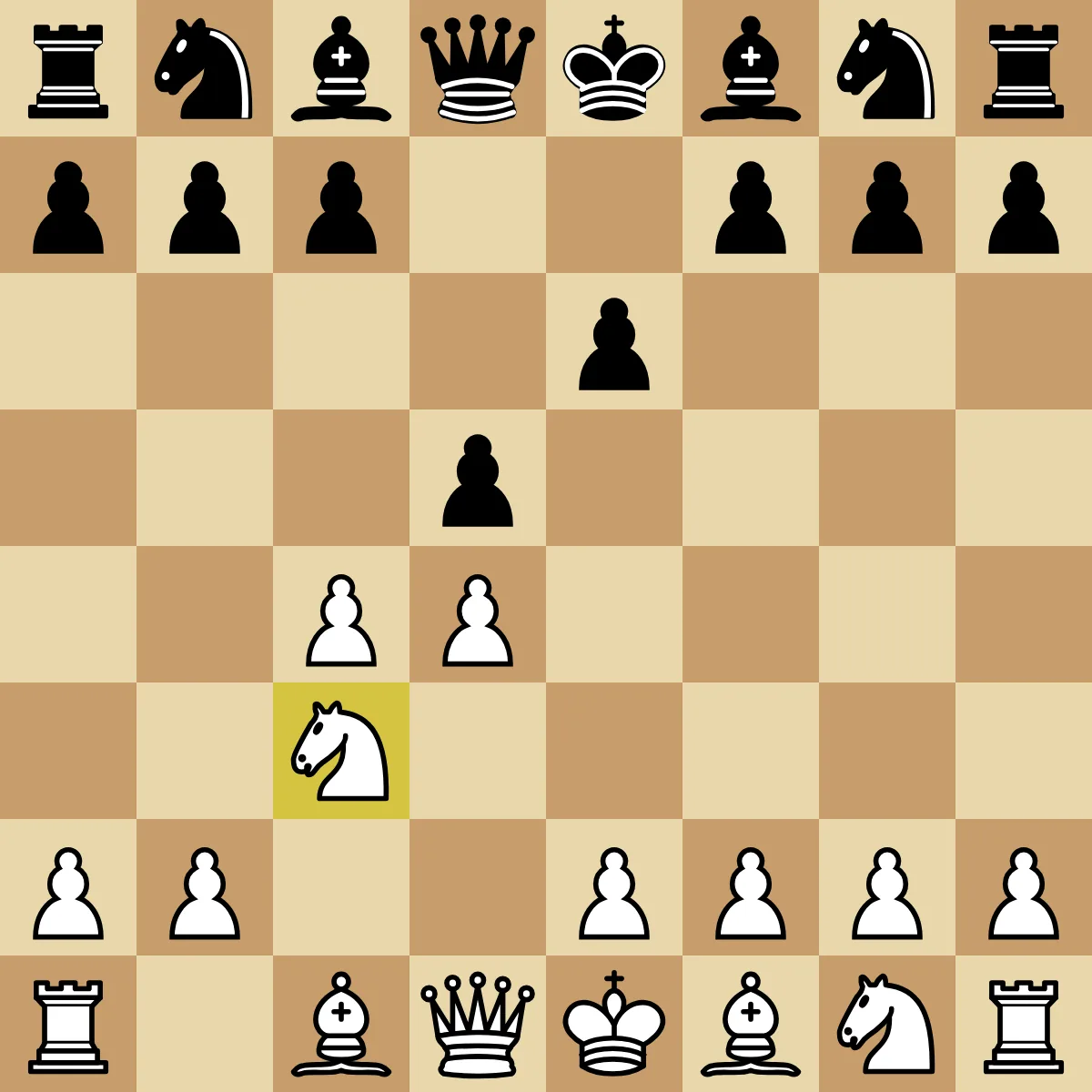
A principle explains development; a line explains why this knight belongs on c3 now.
Opening principles and opening lines solve different problems.
A principle such as “develop your pieces” helps when several moves are playable. A line such as 1.e4 e5 2.Nf3 Nc6 3.Bc4 Nf6 helps when the opponent's choice creates a specific position and your next decision matters. You need the principle to understand the move and the line to recognize when it applies.
The useful question is not which one is better. It is: what does this position demand from memory?
What opening principles are good for
Principles are compact rules for generating candidates:
- influence the center
- develop pieces toward useful squares
- prepare king safety
- avoid spending several early tempi on the same piece without a reason
- notice what the opponent's last move changed
They are especially useful in unfamiliar positions. If your opponent plays a harmless move outside your preparation, principles give you a way to continue instead of searching your memory for a line that no longer exists.
They also make theory easier to remember. In the Italian Game, Nf3 develops a piece and attacks e5. Bc4 develops toward f7 and keeps castling available. Those reasons give the moves a structure.
But a principle does not choose a move automatically. “Control the center” can support e4, d4, c4, or a piece move that increases pressure. The board still has to decide.
What a concrete line adds
A line records how general ideas survive contact with an opponent's reply.
Consider the Queen's Gambit position after 1.d4 d5 2.c4 e6. Developing a knight is sensible, but 3.Nc3 is not merely a generic developing move. The knight increases pressure on d5 and supports a later e4. Its purpose belongs to this pawn structure.
Concrete lines become valuable when:
- one reply changes the pawn structure
- a natural move permits a tactic
- move order changes whether a plan works
- a recurring position has one demanding decision
- you repeatedly lose time trying to reconstruct the same answer
That does not mean you should memorize every continuation. Learn the branch up to the point where you can recognize the position and explain your plan.
Use a three-part note for every important move
Record:
- Cue: what changed on the board?
- Move: what do I play?
- Purpose: what does it solve or prepare?
Example:
Cue: Black supports d5 with ...e6 and closes the c8 bishop.
Move: Nc3.
Purpose: Add pressure to d5 and support a later e4 break.
This is more retrievable than a paragraph and more useful than bare notation.
Two boards: a forced task and a flexible choice
Set up 1.e4 d5 2.exd5 Qxd5 3.Nc3 Qe5+. White is in check along the e-file. The usual developing move Nf3 is illegal here because it leaves the king in check. 4.Be2 blocks the check and develops a bishop. It is one legal answer, not a claim that every other answer loses. The cue worth remembering is the open e-file and the check, rather than the opening's name.
Now compare 1.d4 d5 2.c4 e6 3.Nc3 Nf6 4.Bg5 Be7. White is not in check. 5.e3 opens the f1 bishop's diagonal and supports d4; 5.Nf3 develops the knight and also supports d4. Both serve development. A sample continuation is 5.e3 O-O 6.Nf3. Black need not follow that script, so inspect each reply before continuing.
| Position | Cue | A move | Purpose and next check |
|---|---|---|---|
Scandinavian after 3...Qe5+ | King in check on the e-file | 4.Be2 | Block the check; reassess Black's queen move |
Queen's Gambit after 4...Be7 | Development unfinished; no check | 5.e3 | Release the f1 bishop; compare development after Black replies |
Cover the move column. Name the cue, choose a legal move, then explain what it changes. If you recall Be2 but miss that the king is in check, keep the cue in your review. If you choose Nf3 in the Queen's Gambit with a sound reason, do not mark understanding as failed just because your saved line says e3. Exact repertoire recall and a playable independent choice are different checks.
Compare e3 and Nf3, then reset to try the other move. These are two candidates, not the only legal moves.
Compare e3 and Nf3, then reset to try the other move. These are two candidates, not the only legal moves.
For the full structure behind the second board, use the Queen's Gambit guide. This exercise decides what to memorize; the memorization tutorial explains how to schedule and maintain it.
The danger of using only principles
Players often say, “I will just follow principles,” when they are trying to avoid theory. That works until two principled moves have very different consequences.
Early queen moves are usually suspicious, but sometimes the queen must recapture. Moving the same piece twice can waste time, but it can also answer a threat. Castling is usually sensible, but not if the destination is tactically unsafe. A principle is a default, not a law.
If the same position keeps causing trouble, refusing to learn its concrete feature is not flexibility. It is repeating the same guess.
The danger of using only lines
The opposite failure is treating notation like a script. You can replay 1.e4 e5 2.Nf3 Nc6 3.Bc4 Bc5 perfectly and still feel lost after 3...Nf6.
The memorized move may be legal in the new position but wrong for the new problem. A script does not tell you what changed. It also gives little help when the opponent leaves the branch.
This is why memorizing openings with the plan attached is more durable than learning a string of SAN. The line supplies the decision; the idea supplies a way back when the exact move fades.
Check tactics before following the plan
A player may understand the “general plan” and still overlook a tactic. Before following a strategic idea, check:
- checks
- captures
- direct threats
- loose pieces
- whether the opponent's last move prevented your idea
Plans operate under tactical permission. Opening knowledge should narrow candidates, not switch off calculation.
A practical order for learning both
Use this sequence for one opening:
- Learn the opening's central conflict in one sentence.
- Identify the opponent's first move that changes the structure or creates a threat.
- Learn one concrete answer to that move.
- Attach a visible board cue and a short reason to your answer.
- Replay the line from the decision point, not always from move one.
- Test an unfamiliar but sensible opponent move and continue from principles.
For the Caro-Kann Advance, for example, the sentence might be: “Black challenges White's e5 chain and develops the light-squared bishop before closing it in.” The line then teaches how that idea appears after 1.e4 c6 2.d4 d5 3.e5. A later deviation tests whether you understood the structure or only the notation.
What to play after your memorized opening line ends
Your memorized line does not end at the same point as the opening. It ends when the next move no longer comes with a reason you trust.
That moment is normal. Even a large repertoire eventually reaches a position you have not stored. The goal of opening study is not to postpone independent chess forever. It is to arrive at the handoff with development, king safety, and a structure you understand.
When memory stops, use five questions.
1. What did the opponent's last move change?
Do not begin with “What was my line?” Begin with the move on the board.
Did it:
- attack a piece or pawn?
- open a file, rank, or diagonal?
- weaken a square?
- prepare a pawn break?
- prevent your intended move?
A move outside your preparation is not automatically bad. It may be quiet, tactical, or simply a different route into a familiar structure. Treat it as evidence, not an insult to your memory.
If there is a direct threat, answer it. Opening principles do not excuse hanging material.
2. Which side is behind in development or king safety?
Count the pieces doing useful work, not pieces that have merely left their starting squares.
If your king is still in the center and castling is safe, finishing that task may be more urgent than starting a pawn attack. If your opponent has moved the same piece several times, a developing move with tempo may preserve the advantage without requiring a tactic.
Avoid automatic castling. Check the destination first. “Castle early” is a default, not a substitute for looking at the board.
3. What does the pawn structure ask for?
Pawns tell you which plans are plausible.
Look for:
- a central pawn that can be challenged
- a backward or isolated pawn that can become a target
- a pawn chain and its base
- an open file created by an exchange
- a break such as
c4,c5,e4, ore5
In a Queen's Gambit Declined structure, White may build pressure on d5 and prepare a central break. In the Accepted, Black's d-pawn has moved from d5 to c4, changing both space and development. The opening name is shared, but the structure gives different instructions.
4. Which piece has no future yet?
When there is no immediate tactic, improve the least useful piece.
Ask where it would contribute to the central plan. A rook may need an open file. A blocked bishop may need a pawn break or a different diagonal. A knight on the rim may need a route back toward the center.
This question is more precise than “develop a piece.” It connects development to a job.
5. What are my two sensible candidates?
Choose two moves that answer the position. Compare them for:
- tactical safety
- effect on the center
- king safety
- the opponent's strongest reply
- whether the move is easy to follow up
You do not need to discover the engine's first choice to continue a healthy opening. A playable move with a coherent reason is the immediate goal.
A worked handoff from theory
Imagine you prepared a Queen's Gambit line through 1.d4 d5 2.c4 e6 3.Nc3 Nf6 4.Bg5 Be7, then forget the next move.
The board gives you a usable reconstruction:
- there is no direct threat demanding a response
- both kings still need safety
- Black's d5 pawn is supported by e6
- White can continue development and prepare a central decision
e3andNf3are sensible candidates with clear purposes
You may not recall the exact order. You can still avoid a random pawn move because the structure narrows the task.
If order matters tactically, note the position after the game and study it. During the game, calculate the candidates in front of you.
Use errors to decide what to study next
After a game, label the first opening problem:
- principle failure: you ignored development, king safety, or the opponent's threat
- line failure: you reached a prepared position but could not recall the answer
- understanding failure: you remembered the move but had no idea what to do next
- scope failure: the opponent used a common reply missing from your repertoire
Each diagnosis leads to different work. A principle failure needs a clearer decision checklist. A line failure needs recall from the board. An understanding failure needs an explanation or model position. A scope failure may justify one new branch.
Do not prescribe ten new lines for every loss.
The right balance changes as you improve
A beginner needs principles early because unfamiliar positions appear constantly. Short concrete lines then prevent repeated mistakes in the openings they actually play.
As your repertoire grows, you will know more positions specifically. Principles do not disappear. They become the connective tissue between remembered positions.
When your opponent leaves a line, use the process in our deviation guide: check the threat, compare the changed structure, develop the least active piece, and only add theory if the move creates a recurring problem.
Chessmate's Study notes connect a move to its position, while Review and Challenge ask for the move without showing the answer. Disclosure: Chessmate is our product. The broader method works with any board and notebook: explain the idea, learn the decision, then test both in a nearby position.
Opening principles tell you what sensible chess tends to look like. Opening lines teach you where “sensible” becomes concrete.
Sources
Master openings.
Learn curated lines, recall the move from the board, and keep useful positions fresh with spaced review.