How to memorize chess openings without losing the plan
Learn a practical way to remember chess openings by connecting moves to board cues, reasons, recall attempts, and later review.
By Chessmate Team · Updated October 9, 2026
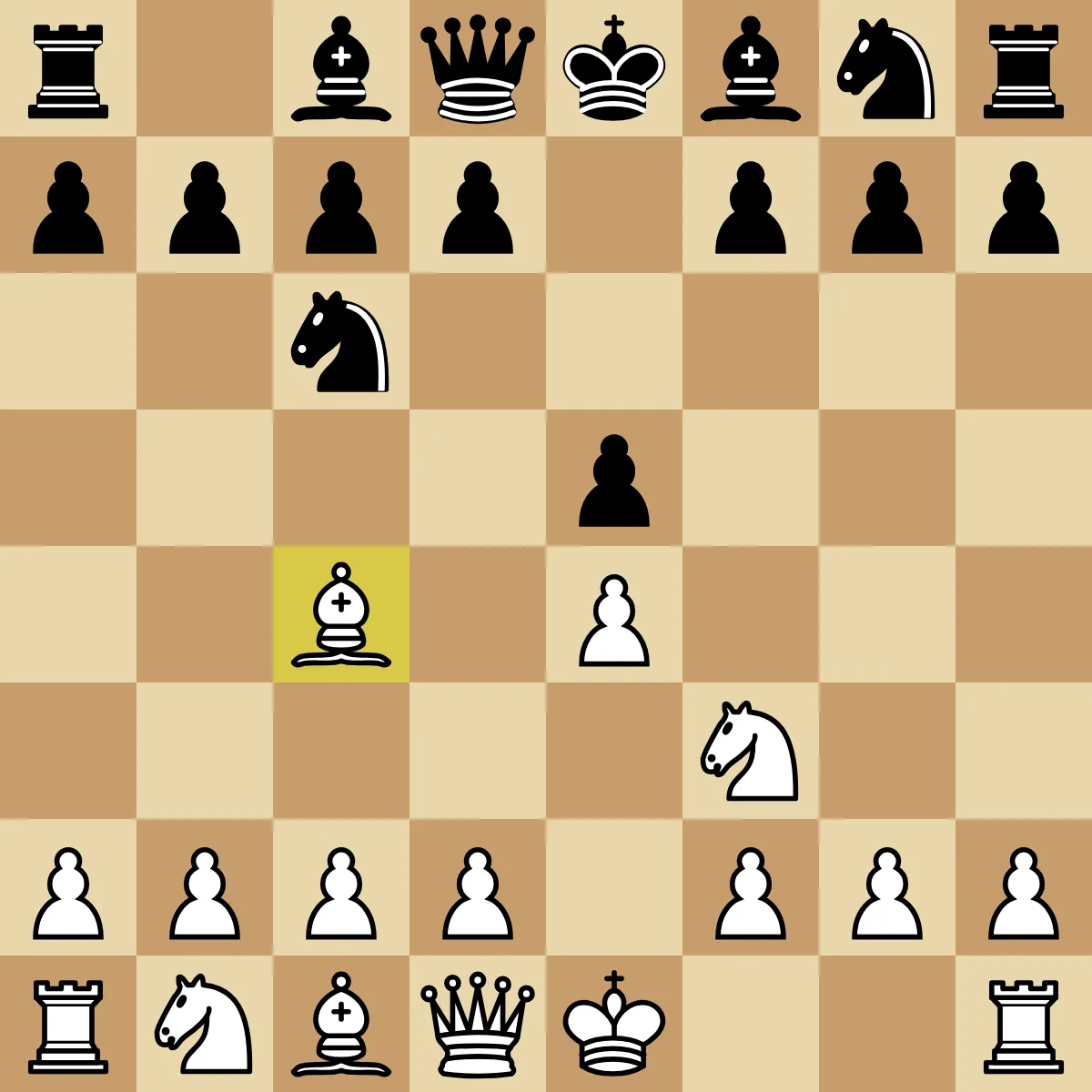
Position after 1.e4 e5 2.Nf3 Nc6 3.Bc4.
An opening line can feel familiar on a study screen and disappear in the next game. The difference often shows up at the first branch: you recognize the position, but the move does not come back without the notation or explanation beside it.
A useful memorization method turns one line into a series of decisions. Each decision starts with the opponent's move and the current board. You try to produce your response, check it, and connect it to a short reason. Later review tests whether the move is still available after the study session has faded.
The larger opening routine also includes choosing openings, playing games, and deciding when to add branches. Our guide to practicing chess openings online covers those decisions; the steps below focus on making one practical line easier to recall.
Start with one useful line
Choose a line that reaches a position you expect to play, then stop at the first useful plan. A new Italian Game player might begin with 1.e4 e5 2.Nf3 Nc6 3.Bc4 Bc5 4.c3 Nf6 5.d4. That is enough material to connect development on c4 with the later center break.
The first line should stay small enough to replay without consulting a tree. Adding many nearby sidelines at once makes the decisions harder to separate. One main reply gives you a stable path, and a second branch can wait until it appears in your games.
Use a family guide to understand where the line belongs, then use a course for the moves you will train. The Italian Game guide explains the family, while the Italian Game course provides a concrete White line. To test recall right away, play that line in the free chess opening trainer: learn it with short notes, then play it again from memory.
Turn the line into decisions
An opening line becomes easier to recall when each of your moves answers a visible board cue. The useful unit has three parts: the board after the opponent's move, your response, and the reason that connects them.
Consider the Italian position after 3...Bc5. Black's bishop now points toward f2, both sides are developing, and White still wants to build the center. The move 4.c3 prepares d4. Remembering that relationship gives c3 a job instead of leaving it as the fourth symbol in a move list.
Branch points deserve separate decisions. After 3.Bc4, Black's 3...Bc5 and 3...Nf6 may share earlier moves, but they create different questions. Train each reply from the position where it first changes your response.
Give each move a short reason
A useful reason should be short enough to recall while looking at the board. "Prepare d4" works for c3 in many Italian positions. A paragraph about every strategic consequence is harder to carry into a rapid game.
Reasons also help when the exact move slips. If you remember that your plan is to challenge the center, you can inspect candidate moves that support that plan. Understanding does not guarantee the theoretical move, but it gives you a way to reconstruct the choice and continue after preparation ends.
Concrete tactics still need concrete memory. In the Petroff, 1.e4 e5 2.Nf3 Nf6 3.Nxe5 is usually met by 3...d6 before Black captures on e4. The reason is tactical timing, so a general instruction such as "develop normally" is not enough.
Recall the move before revealing it
Trying to produce the move tells you more than rereading it. A navigation route can look obvious while the map is open and vanish as soon as you put the phone away. Opening notation creates the same kind of support: the next move is easy to recognize when it is already on the screen.
In a 2006 experiment, students who repeatedly recalled studied prose retained more on delayed tests than students who restudied it, even though restudy produced greater confidence. The experiment did not test chess openings, but it shows why an attempted answer can reveal something rereading cannot. The original study by Roediger and Karpicke is one of the main sources behind retrieval-practice research.
For an opening line, hide the continuation and stop after the opponent's move. Play your response on the board before checking the course. A correct move confirms that the position can cue the answer. A miss identifies the exact decision that needs another look.
Correct the decision you missed
A missed move needs feedback while the position is still clear. Return to the board, compare your move with the course move, and read the reason attached to the difference. Then reset the position and try the decision again.
Correct the missed decision instead of restarting the entire line. Beginning a fifteen-move line after every error spends most of the session replaying moves you already know. Resume a few moves before the miss when you need the buildup, then test the difficult decision once more.
Some positions allow more than one playable move. An opening course teaches a selected repertoire move, not the only legal way to play chess. Memorize the course choice and its purpose without treating every alternative as a blunder.
Review the line after a delay
A later review checks whether the line survived beyond the original session. Replaying it five times in a row mostly tests whether the previous attempt is still active. Waiting creates a more useful test of whether the board can bring the move back.
Review timing and recall are separate decisions. Spaced repetition decides when the line returns. Retrieval practice describes trying to produce the move when it returns. For a first routine, bring a missed line back sooner and let a stable line wait longer. Our guide to spaced repetition for chess openings examines the scheduling research and its limits in more detail.
No fixed interval works for every opening or learner. Research on distributed practice shows that useful gaps depend partly on how long the material must be retained. A schedule should respond to later performance instead of forcing every line through the same calendar.
Use games to choose the next branch
Real games show where the first line stops being useful. If opponents repeatedly play 3...Nf6 while you only trained 3...Bc5, the next project is the Two Knights branch. If a rare sideline never appears, it does not need equal review time.
Review the first unfamiliar position after a game. Check the move and its reason, then decide whether that position deserves a place in your training set. This keeps the repertoire connected to situations you face rather than to the size of an opening tree.
Why you forget chess openings in real games
You know the opening name, recognize the first moves, and still go blank when the familiar position reaches your board. That moment can feel like a memory problem, but several different practice failures can produce the same result.
The useful diagnosis depends on what you can do outside the game. Perhaps the line looks familiar only when the moves are visible. Perhaps two opponent replies blur together. Perhaps you can recite the notation but cannot find the move from the board. Each symptom points to a different correction.
Diagnose the failure mode before adding more theory or study time. Each symptom below has a smaller, more direct correction.
Your study prompt does not match the game
A game presents a board position, not a chapter title or a visible PGN. If you learned the line mainly as notation, the cues available during study may be missing when your clock is running.
Tulving and Thomson's work on encoding specificity examined how retrieval depends on the relationship between stored information and available cues. Applying that idea to openings is an inference, not a chess-specific experimental result. It suggests a practical design choice: practice with the same kind of prompt the game will provide.
Use the board after the opponent's move as the prompt. Notice what changed, including a new attack, a pawn break, or a piece that blocks development. Then recall the course move from that position instead of reciting the line from move one every time.
Similar branches blur together
Nearby branches are easy to confuse when they share the same first moves. In the Italian Game, 3...Bc5 and 3...Nf6 look similar in notation, but one develops the bishop and the other attacks e4 with the knight.
Training both branches as one long list can hide the exact point where your response changes. You may remember c3, d3, or Ng5 from the course and still attach the move to the wrong Black setup.
Separate each branch at the opponent move that creates a new decision. Practice the position after 3...Bc5 on its own, then practice the position after 3...Nf6. A clear branch cue is more useful than another replay of the shared first three moves.
Diagnose the blank moment
Each symptom points toward a specific correction.
- If the answer looks familiar only after it appears, attempt recall before revealing it.
- If you can recite notation but freeze at the board, practice from the position after the opponent's move.
- If two variations trade places in your head, separate them at their first meaningful branch.
- If the move disappears with no way to reconstruct it, attach one short reason.
- If the line works today and vanishes next week, review it after a delay.
- If the queue keeps growing, remove branches that have not earned their review cost.
Fix one failure mode before rebuilding the whole repertoire. The right correction may be one board prompt, one explanation, or one later review.
How Chessmate supports the method
Disclosure: Chessmate is our product. The steps above also work with a physical board, a study file, or another trainer that can hide the continuation.
Chessmate teaches curated lines in Study, Review, and Challenge. Study keeps a short explanation beside the board. Review brings trained positions back later, and Challenge asks you to play the course move from memory.
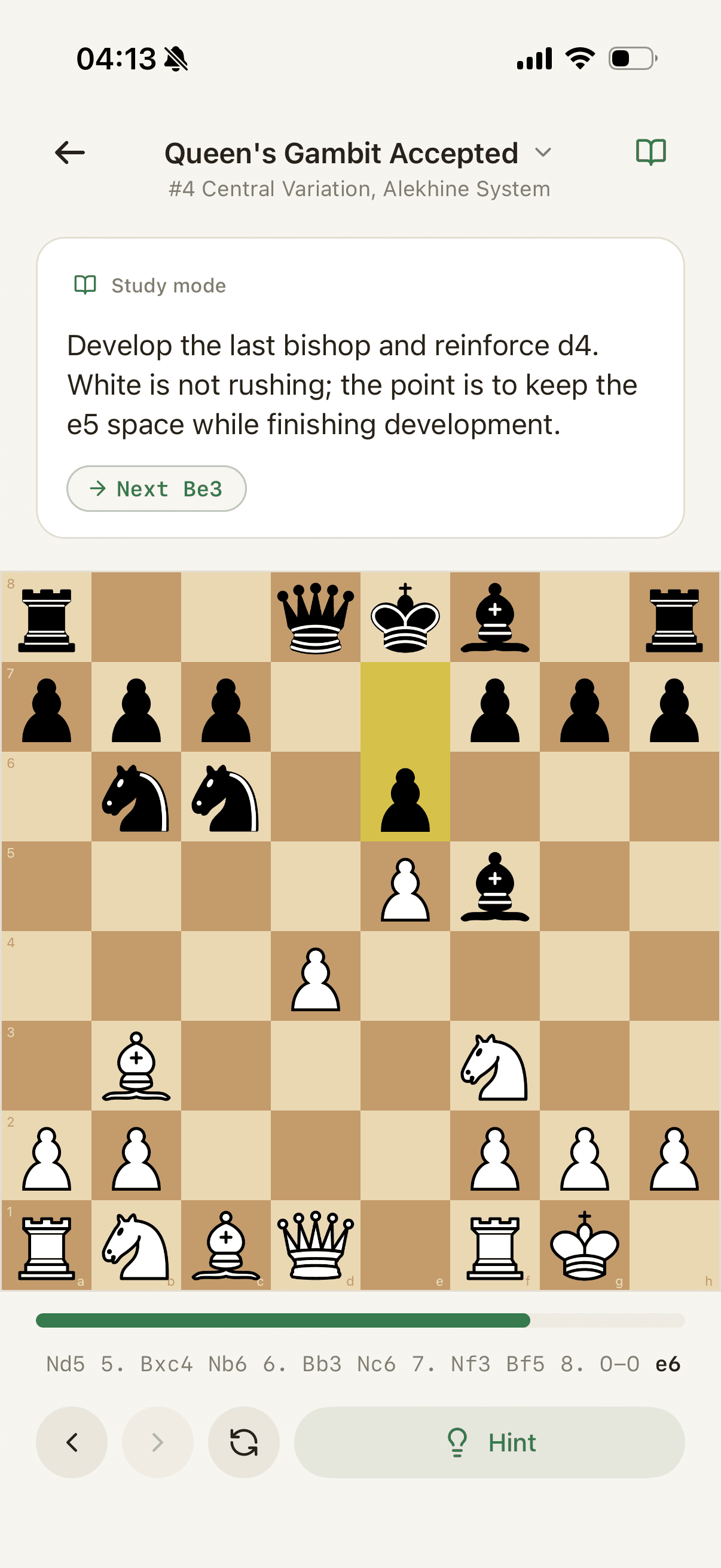
The catalog also labels each course by repertoire side. That matters when a family contains courses for both players, such as the Italian Game or Sicilian Defense. Check the side first, then memorize the decisions that belong to your repertoire.
A line becomes usable when the board itself can prompt the next decision. Keep the first path short, attach a reason to every move you own, attempt the response without help, and revisit the misses later. Add another branch when your games make it necessary.
References
Roediger and Karpicke (2006), Test-enhanced learning; Karpicke and Roediger (2008), The critical importance of retrieval for learning; Tulving and Thomson (1973), Encoding specificity and retrieval processes; Cepeda et al. (2006), Distributed practice.
Master openings.
Learn curated lines, recall the move from the board, and keep useful positions fresh with spaced review.