How to practice chess openings online
Build a chess opening practice routine online: choose useful lines, recall moves from the board, review positions, and add branches from real games.
By Chessmate Team · Updated October 9, 2026
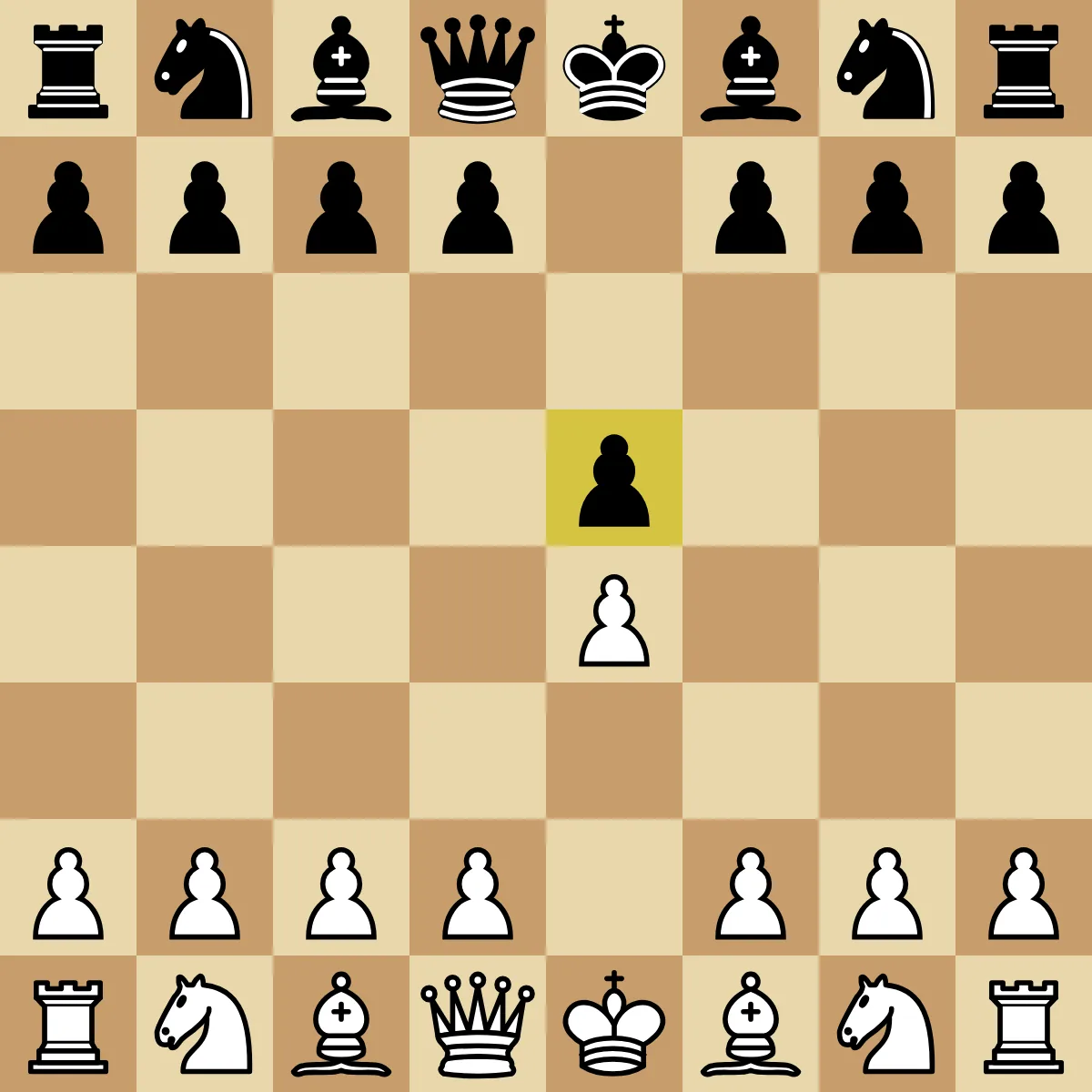
Position after 1.e4 e5.
Chess opening practice works when a familiar position brings the next move back. If you study openings online and still forget what to play, the problem may be the way the session is organized.
A common starting point is an opening page, an explorer, or a video. Those resources can show you what exists, but they do not test whether you can see a familiar position on the board and choose a move.
A useful chess opening practice routine stays small and requires you to play the moves. Pick one opening you reach, learn one practical line, review the position later, and add branches when they start appearing in your games.
Start with the opening you already reach
Begin with an opening that already appears in your games.
If you play 1.e4 and often see 1...e5, the Italian Game, Scotch Game, Vienna Game, or Ruy Lopez might be the right place to start. If you play 1.d4, the Queen's Gambit may give you a clearer first repertoire. If you need a Black opening against 1.e4, the Caro-Kann Defense, French Defense, or Petroff Defense can be easier to organize than learning every Sicilian at once.
Choose one job first. That might be one White opening, one Black response to 1.e4, or one Black response to 1.d4. Add a sideline only when it keeps appearing in your games. A small opening repertoire you can recall is more useful than a large one you only recognize by name. If you have not chosen that first job yet, our guide to beginner chess openings compares manageable starting points by repertoire side.
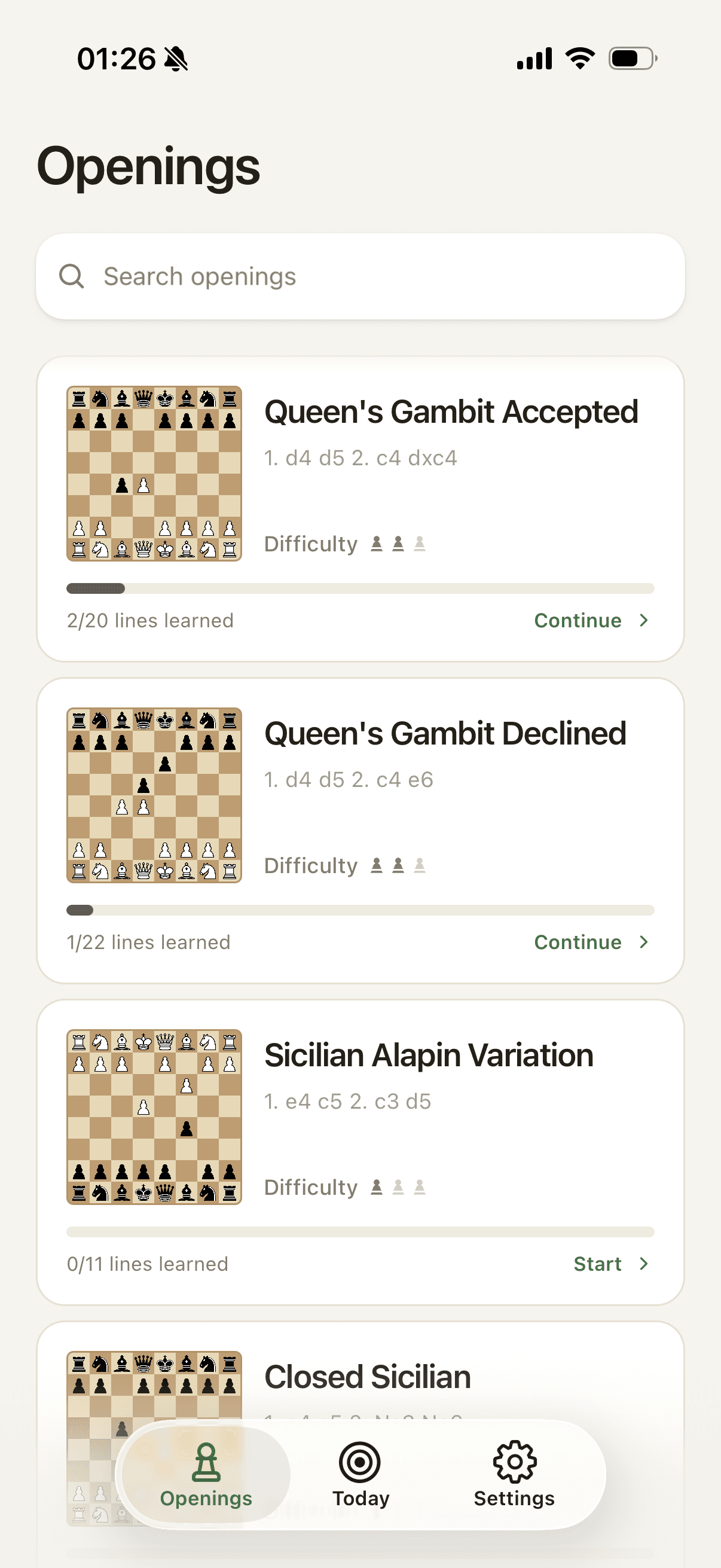
Use an opening explorer for research
Opening explorers answer research questions about names, common continuations, and move trees. Lichess has a free openings page, and Chess.com has an openings section for browsing lines and book moves.
Use them to answer research questions:
- What are the common replies in this position?
- Which branch do players choose most often?
- Does this opening usually stay quiet or open quickly?
- Which position do I keep reaching in my own games?
An explorer can show the common continuations. Practice begins when you have to choose and play a move yourself. The opening trainer and explorer comparison explains how to move from a database question to a recall prompt without importing the whole tree.
A chess opening trainer should make you look at the board, recall the move, and play it. That gives you the same prompt you will receive in a game: the position itself.
If you are still choosing a tool, compare chess opening trainer apps by the kind of practice they support.
Learn the idea before the move order gets long
Opening principles still matter. Chess.com teaches beginner opening ideas such as controlling the center, developing pieces, and getting the king safe in its opening principles lessons. Those ideas are a good foundation.
Opening principles explain why a line works. Theory shows how those ideas appear in a particular move order.
For a beginner-to-intermediate player, a good opening line should answer three questions:
- What is my side trying to do?
- What is the opponent's main reply?
- What position am I trying to recognize later?
Take the Italian Game as an example: 1.e4 e5 2.Nf3 Nc6 3.Bc4. White develops, attacks f7, and keeps castling easy. Once you understand that, the branch between 3...Bc5 and 3...Nf6 becomes meaningful because each move leads to a different kind of game.
A line with no idea attached is hard to remember under time pressure. Our guide to memorizing chess openings turns one useful line into a series of board decisions, attempted moves, and short reasons.
Train one line until the position feels familiar
Start with one line and leave the five-branch tree for later. Train that line until the position itself reminds you what to play.
Keep the session short:
- Open one course or line.
- Read the explanation for the first important move.
- Play the move on the board.
- Continue until the line reaches a stable position or first branch.
- Close the line and replay it from memory.
- Mark the position for review.
If you only play a line once, it may feel clear today and disappear tomorrow. Listudy describes spaced repetition for chess as a way to bring material back over time, and its opening workflow asks players to learn by playing against an opening repertoire. Your opening notes should turn back into board positions you can recall.
Chessmate uses the same practical idea for openings: learn a curated line, review positions later, then test whether the next move comes back from the board.
How many moves should you prepare for blitz or rapid?
Move count is a poor measure of preparation.
Prepare deeper when:
- the moves are forcing
- one natural response loses material
- a move-order detail changes the position sharply
- the same branch appears often
Stop earlier when:
- several healthy moves are available
- the target structure and plans are clear
- later play depends more on calculation than recall
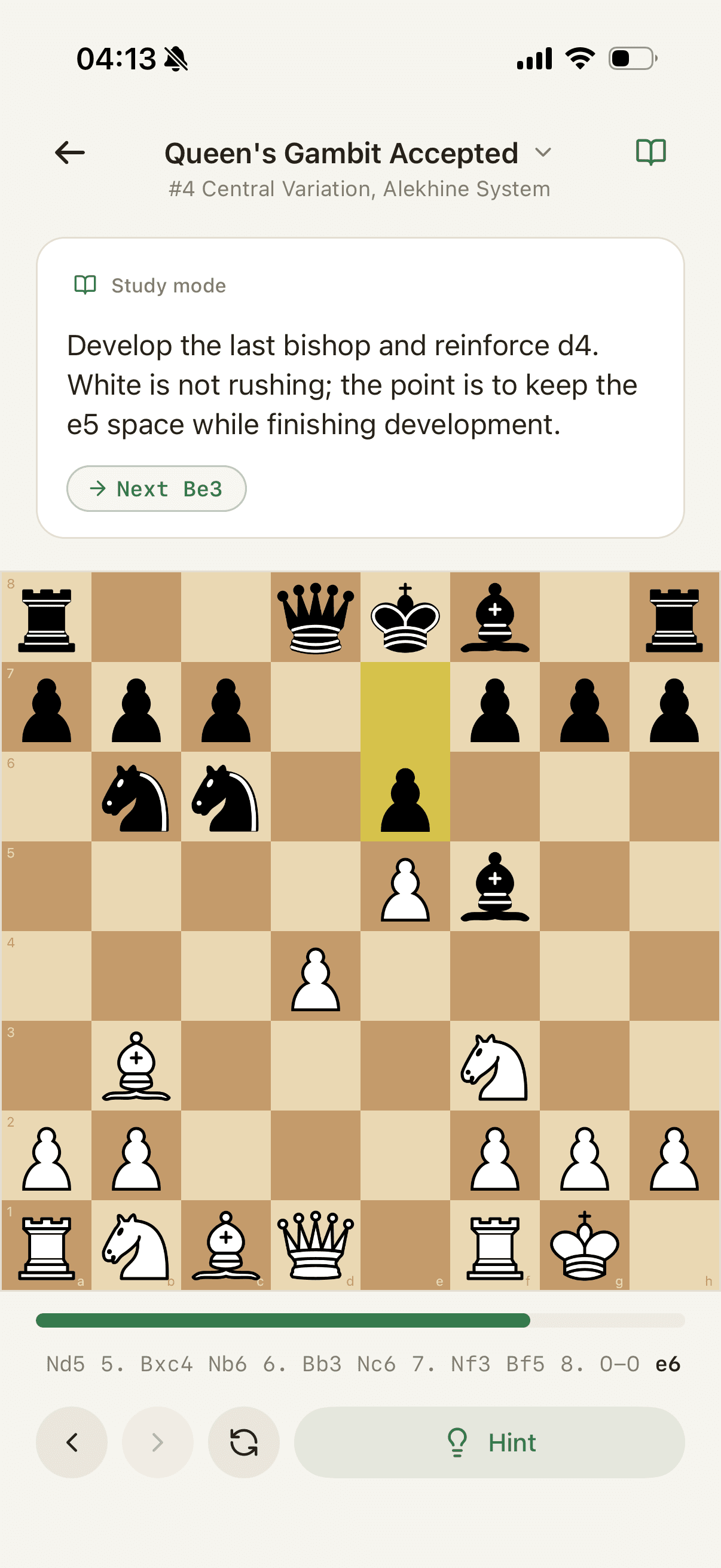
A quiet Queen's Gambit structure may need a handful of decisions and a clear pawn-break plan. A tactical gambit may require a longer concrete answer. “Ten moves in every line” fits neither.
Add branches only when they solve a real problem
Opening practice becomes hard to maintain when you add every possible branch too early.
Instead, add branches when one of these things happens:
- You keep seeing a specific reply in online games.
- You lose quickly in the same position more than once.
- Your current line reaches a position where you never know the plan.
- A common opponent move changes both the structure and the move order.
For example, if you are learning the Italian Game, it makes sense to learn what changes after 3...Bc5 and 3...Nf6. Those moves create different plans. Memorizing a rare sideline that has never appeared in your games is probably wasted time. When an unfamiliar move does appear, our guide to leaving the opening line shows how to check the threat and the changed position before adding another branch.
Course pages and family guides work best as a pair. A family guide explains the opening's main branches. A course gives you a trainable line. For example, the Italian Game guide explains the family, while the Two Knights Defense for White course gives you a specific branch to practice.
Review the position first
Many players can say "I play the Caro-Kann" and still forget what to do after 1.e4 c6 2.d4 d5 3.e5. A label that broad cannot supply the next move. The board position carries the useful cue.
When you review, ask yourself:
- What is the opponent threatening?
- Which pawn structure am I in?
- Which piece should improve next?
- What was the move I trained for this exact position?
Review from the board instead of relying on a line list. In a real game, you do not see the opening name or chapter title. You see a position, your clock is running, and you need a playable move.
Diagnose the miss before correcting it
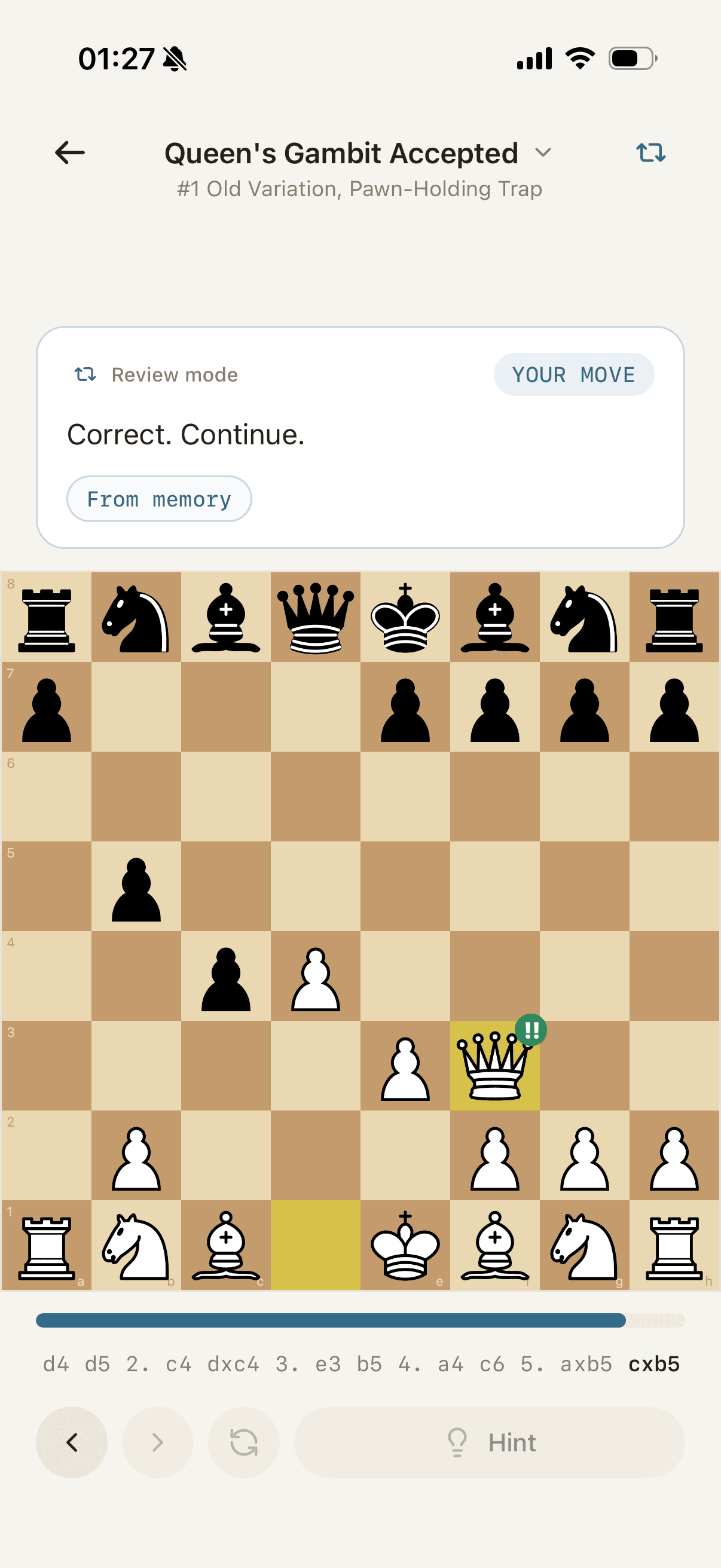
An incorrect move can come from several failures:
- position miss: you did not recognize the branch
- move miss: you recognized it but could not produce the answer
- reason miss: you remembered the move but not what it accomplishes
- interference: a move from a nearby branch came to mind
- scope gap: the position was never in your repertoire
Do not respond to every miss by replaying the whole line. Fix the smallest broken part.
For interference, compare the two positions and name the changed feature. For a reason miss, write one concrete sentence. For a scope gap, decide whether the reply is common enough to deserve a branch.
Separate new, fragile, and stable positions
A simple review queue needs only three states:
- new: learned but not yet recalled successfully
- fragile: missed, hinted, or confused with another branch
- stable: recalled with a correct reason more than once over time
New and fragile positions should return sooner. Stable positions can wait. If a stable position fails in a game, bring it back to fragile.
Distributed-practice research shows that spacing and the desired retention period interact. There is no universal interval that is best for all material. Use success and failure to adjust the delay rather than worshipping a fixed schedule. See the Cepeda et al. review.
A 15-minute daily chess opening training routine
Fifteen minutes is enough for a real opening session. It is not enough for browsing three databases, watching half a video, and adding twelve lines you will never review.
The routine below has one purpose: leave with a small number of positions you can answer more reliably than when you started.
Minutes 0-2: choose today's problem
Open one of these:
- a position missed in your last game
- a fragile branch from your review queue
- the next common reply missing from your repertoire
Choose one. If you begin by scrolling the entire catalog, the session will disappear into selection.
Name the job in a sentence: “Review my response to the Caro-Kann Advance,” or “Fix the move order after Black develops the knight first.”
Minutes 2-6: recall weak positions
Review three to five positions without notes. For each one:
- inspect the opponent's last move
- choose your response
- say the reason aloud or in one short sentence
- check the answer
If you miss, mark the type of miss: position, move, reason, or interference from another branch.
Do not spend all four minutes grinding one position. Correct it, make one clean attempt, and let it return later.
Minutes 6-10: learn one decision
“One decision” is smaller than “one line.” It includes:
- the position before the opponent's meaningful reply
- the reply
- your move
- the board feature that makes the move useful
- a short continuation to a stable position
For example, after 1.d4 d5 2.c4 e6, Black has supported d5 and closed the c8 bishop's natural diagonal. White's next developing move should fit the pressure on the center. That is a decision you can recognize later.
Try your move before revealing it. Research on retrieval practice distinguishes attempting an answer from seeing it repeatedly. A well-known study used prose, not chess, so apply the finding modestly: your session should contain actual attempts, not only exposure. See Roediger and Karpicke (2006).
Minutes 10-13: test without support
Reset to the decision point. Hide the explanation, arrows, and notation.
Play through the branch once. If you fail, return to the exact missed position instead of restarting the whole opening. Finish with one correct attempt and its reason.
Then test one nearby reply. The goal is not to know its full theory. Ask whether your opening principles and structure knowledge still produce a sensible candidate.
This prevents a new line from becoming a brittle script.
Minutes 13-15: connect the session to play
Write two lines:
Today I fixed: ...
In my next games I will notice: ...
If the position came from a game, link the note to that game. If it did not, define the trigger that will make it relevant: “when Black supports d5 with e6,” or “when White advances e5.”
End the session. Do not reward completion by importing five more variations.
A weekly schedule you can keep
Three sessions are enough to run the plan:
- Monday, 20 minutes: learn or repair one branch
- Wednesday, 15 minutes: recall trained positions without notes
- Weekend, 20 minutes: inspect recent games and update one branch
On other days, play. The games supply the evidence that decides what deserves study time.
If you have only 15 minutes, keep the weekly priorities and shorten the session.
Avoid the online-prep traps
Three habits waste preparation time:
Changing openings after every loss. The loss may have happened later, and changing prevents familiarity.
Studying traps as the whole repertoire. A trap depends on cooperation. Prepare the sound position after the opponent avoids it.
Copying elite depth without elite context. A line can be theoretically important and practically rare in your games. Learn enough to understand why it matters before allocating repeated review.
What Chessmate adds to online opening practice
Chessmate adds curated lines, explanations beside the board, and recall practice to an online opening routine. Disclosure: Chessmate is our product, so this section is product-specific. The advice above still applies no matter which tool you use.
Chessmate is built for players who want a focused chess opening trainer rather than a full database. It moves positions through Study, Review, and Challenge so the next move has a chance to stick.
The workflow is:
- Study the line with the board in front of you.
- Read short notes for moves that matter.
- Review positions later instead of starting from scratch every time.
- Challenge yourself to play the trained move from memory.
- Browse openings by family in the opening catalog, then train a specific course.
An opening explorer is enough when you are still exploring what exists. When your problem is remembering the move in real games, you need recall practice.
Keep the theory under control. A sustainable chess opening practice routine uses an explorer for research, connects each line to an idea, asks for moves from the board, and returns to the position later. Keep the repertoire small enough that the next move can come back when you need it.
Master openings.
Learn curated lines, recall the move from the board, and keep useful positions fresh with spaced review.