
Best chess openings for Black: beginner-friendly choices
Compare practical chess openings for Black against 1.e4 and 1.d4, including the Caro-Kann, Petroff, French, and direct queen-pawn setups.
By Chessmate Team · Updated October 9, 2026
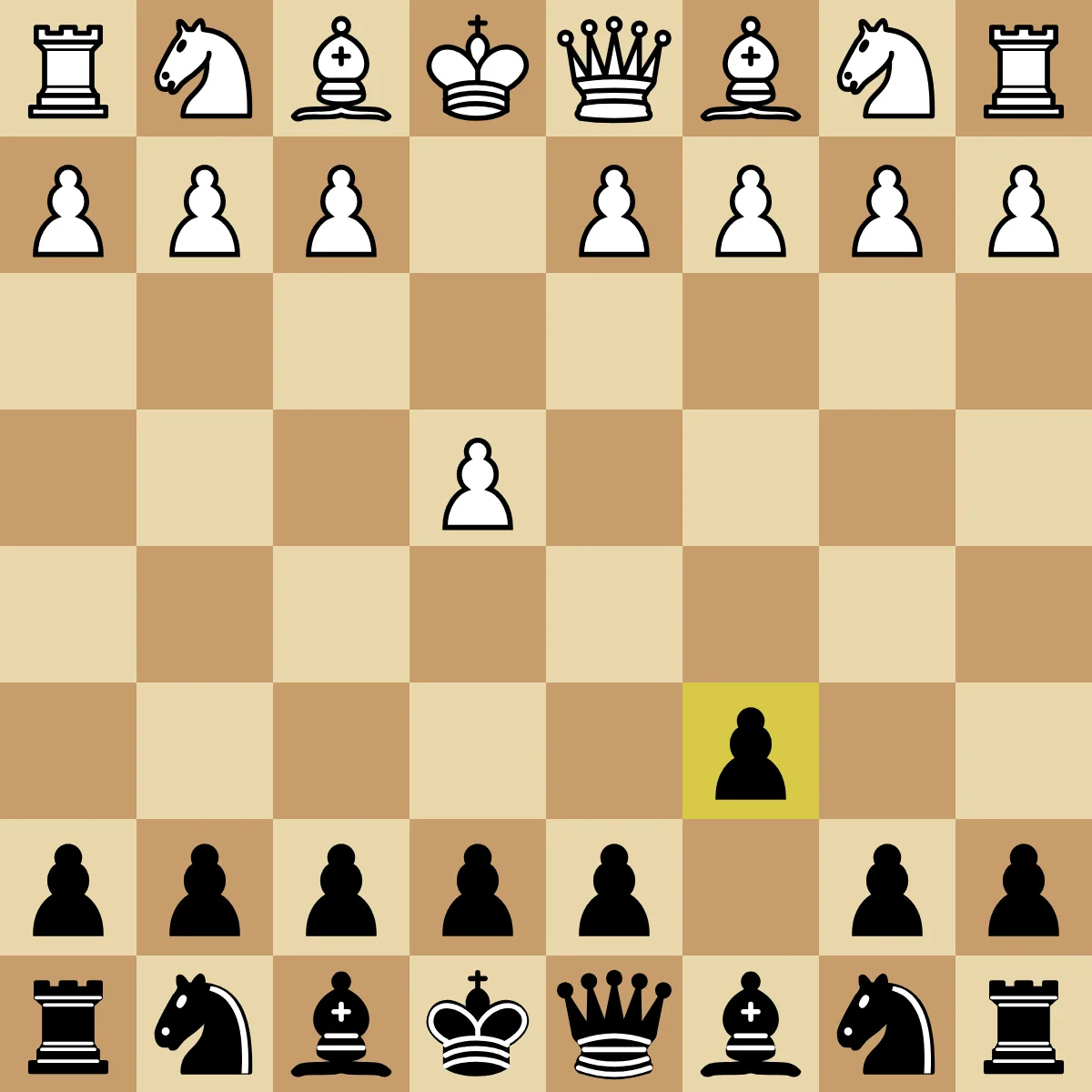
Caro-Kann starting position after 1.e4 c6.
The best chess openings for Black cover two separate jobs: answering 1.e4 and answering 1.d4. A beginner-to-intermediate player who chooses only the Caro-Kann or only the Queen's Indian leaves half of the first-move work undone.
The most manageable choice is the defense whose central plan you can explain after White changes the move order. Against 1.e4, the Caro-Kann, Petroff, and French provide three different but recurring structures. Against 1.d4, a direct 1...d5 setup gives a beginner a clear central reference before more specialized defenses enter the repertoire.
Compare the first training commitment behind each choice. By the end, you should have one usable answer to each White first move and know which branches can wait. If you would rather start from your rating and playing style, the opening quiz suggests a reply to 1.e4 to try first, plus a reply to 1.d4 once you are ready for one.
Choose one answer to 1.e4
White's king-pawn move claims central space and opens lines for the queen and bishop. Black can challenge that center immediately, prepare a challenge, or create an asymmetrical fight.
Three beginner options differ mainly in how they handle e4:
| Defense | First moves | Central idea | First branch to train |
|---|---|---|---|
| Caro-Kann | 1.e4 c6 2.d4 d5 | Prepare ...d5 with the c-pawn | White advances, protects, or exchanges e4 |
| Petroff | 1.e4 e5 2.Nf3 Nf6 | Counterattack e4 | The timing after 3.Nxe5 |
| French | 1.e4 e6 2.d4 d5 | Challenge e4 and attack the pawn chain | White's third move |
The moves are only the entrance. Your first course should teach the position after White makes the choice that changes Black's plan.
Caro-Kann: prepare a stable central challenge
The Caro-Kann Defense begins with 1.e4 c6. Black prepares ...d5 and often develops the light-squared bishop before ...e6 closes its diagonal.
White's third move organizes the repertoire. After 3.e5, Black faces a closed center and usually develops the bishop before attacking d4 with ...c5. After 3.Nc3 or 3.Nd2, Black can release the tension on e4 and develop into a more open structure.
The Caro-Kann is a strong first choice for a player who wants recurring structures and does not mind learning why the bishop changes squares. The Caro-Kann course is Black and Core. Our Caro-Kann beginner guide gives the Advance and capture structures a practical order.
Petroff: counterattack instead of defending
The Petroff Defense starts with 1.e4 e5 2.Nf3 Nf6. Black attacks e4 rather than protecting e5 with ...Nc6.
The main timing lesson comes after 3.Nxe5. Black usually inserts 3...d6, moves the White knight, and only then captures on e4. Copying White's capture immediately can allow tactics, so the move order has a visible reason.
The Petroff suits a beginner who likes open development and a direct early question. It also requires a response when White plays 3.Nc3 and moves toward Four Knights structures. The Petroff course is a Black Core course with a smaller current line count than several broader families.
French Defense: attack the pawn chain
The French Defense begins with 1.e4 e6 2.d4 d5. Black challenges White's center and accepts that the light-squared bishop may take longer to develop.
White's third move creates distinct branches. The Advance with 3.e5 closes the center and gives Black a target on d4. The Exchange releases the tension. 3.Nc3 and 3.Nd2 keep more options and lead to their own structures.
The French is a good long-term choice for a player who enjoys attacking a pawn chain with breaks such as ...c5. Its first project is larger than the Caro-Kann or Petroff because the current Chessmate catalog separates the main White choices into different courses. The Exchange course is Core; the Advance, Tarrasch, and 3.Nc3 courses are Advanced.
Why the Sicilian may be a second project
The Sicilian Defense starts with 1.e4 c5 and creates an asymmetrical center immediately. Black fights for d4 with the c-pawn and accepts positions where the two sides may attack on different wings.
Calling the Sicilian one opening hides a large branch decision. The Najdorf, Dragon, 2...e6 systems, and responses to anti-Sicilians place the pieces differently. Learning one does not automatically prepare Black for the others.
Chessmate has several Black Sicilian courses, but most are Advanced. The Alapin course is Core and teaches Black's response after White chooses 2.c3; it is one branch inside a larger Black repertoire, not a complete beginner answer to every second move.
Choose the Sicilian first only if its asymmetry is the reason you want to study it. Otherwise, establish one smaller defense before taking on the broader family.
Start against 1.d4 with a direct center
The simplest conceptual answer to 1.d4 is 1...d5. Black meets White's central pawn with a pawn of its own and makes White decide whether to continue with c4, develop quietly, or choose another setup.
After 1.d4 d5 2.c4, Black can support d5 with 2...e6 and reach a Queen's Gambit Declined structure. The first learning goals are development, the light-squared bishop, and the timing of a central break such as ...c5. This structure also contains the Elephant Trap: after 3.Nc3 Nf6 4.Bg5 Nbd7 5.cxd5 exd5, 6.Nxd5? loses a piece to 6...Nxd5, because 7.Bxd8 Bb4+ wins the queen back. It is one of the chess traps for Black you can practice for free.
Chessmate's current Queen's Gambit courses train White, so they are not a Black repertoire. The family guide can explain the structure, but Black would need a separate course or study source for the actual moves.
Add an Indian defense after you understand the commitment
Black can answer 1.d4 with 1...Nf6 and delay the central pawn decision. That move allows the Queen's Indian, Benoni, and other systems, depending on White's setup and Black's next moves.
The Queen's Indian Defense often appears after 1.d4 Nf6 2.c4 e6 3.Nf3 b6. Black controls central light squares and develops the bishop to b7 or a6. The Benoni and Benko Gambit create more immediate structural imbalances.
These are legitimate repertoire choices, but the current Chessmate courses for the Queen's Indian, Benoni, and Benko are Advanced. Learn them because you want their structures, not because 1...Nf6 looks like a move that postpones theory.
Build the repertoire as two small trees
A workable Black repertoire can begin with two lines:
- one Caro-Kann or Petroff line against
1.e4 - one direct
1...d5line against1.d4
Add White's alternatives only when they reach your games. If a Caro-Kann player repeatedly meets 2.Nf3 instead of 2.d4, that move has earned a place. If a 1...d5 player keeps seeing the London setup, record the first position where the normal plan becomes unclear.
Keeping two trees separate prevents side confusion. A Black move that solves an e4 position does not belong in a d4 structure merely because both openings use ...d5.
Review after White creates the decision
Black always moves second, so the review prompt should include White's last move. In the Caro-Kann, show the position after 3.e5 or 3.Nc3. In the Petroff, show the capture on e5. In a queen-pawn game, show whether White played c4 or built another setup.
This review style makes the opponent's move part of the cue. Replaying Black's first move from an empty board may confirm the opening name without testing the branch where the response changes.
Disclosure: Chessmate is our product. Its current Core Black starting points include the Caro-Kann and Petroff, plus narrower Core courses such as the French Exchange and Sicilian Alapin. Course labels describe the scope in the catalog; they do not make every surrounding family equally small.
A good opening for Black gives you a repeatable answer to one White choice. Build one answer to 1.e4, one answer to 1.d4, and train the position after White's move changes the plan. That pair is more useful than a dozen defense names with no second branch.
Master openings.
Learn curated lines, recall the move from the board, and keep useful positions fresh with spaced review.


Scan to get the app on your phone