
Caro-Kann for beginners: a practical Black opening
Learn what the Caro-Kann asks Black to remember, how White's main third moves change the center, and which positions to train first.
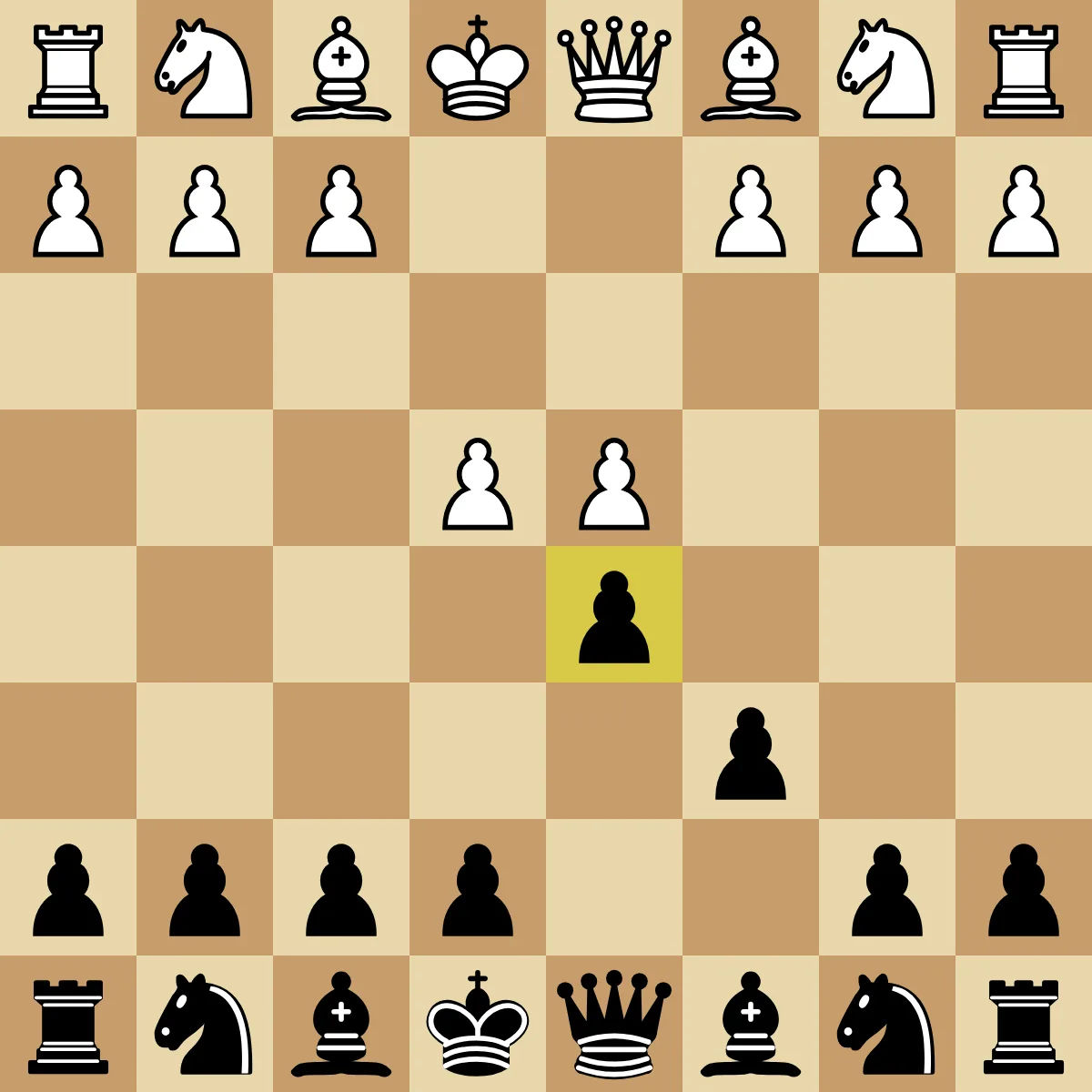
Caro-Kann Defense after 1.e4 c6 2.d4 d5.
The Caro-Kann begins with 1.e4 c6, but the point of ...c6 is the next move. Black prepares ...d5 and challenges White's center without committing the e-pawn first.
The position after 1.e4 c6 2.d4 d5 gives a beginner a stable starting question: how did White respond to the central challenge? White can advance the e-pawn, defend it, exchange in the center, or choose a different second move. Each choice changes Black's development order.
Learn the center before collecting Caro-Kann variation names. The Caro-Kann family guide maps the main branches; this article explains which decisions a new Black player should train first.
What 1...c6 is preparing
Black plays ...c6 to support ...d5. The two moves belong together. If Black delays the central challenge without a concrete reason, White receives extra time to build the center.
The Caro-Kann often differs from the French Defense in the development of Black's light-squared bishop. In many Advance lines, Black can play ...Bf5 before ...e6 closes the diagonal. That timing gives the bishop an active square but may also make it a target.
Black's position is solid only when the pieces find useful squares and the center is challenged at the right time. Black still needs active breaks such as ...c5 and sometimes ...e5 to contest White's space.
First branch: White plays 3.e5
The Advance Variation begins after 1.e4 c6 2.d4 d5 3.e5. White gains space and closes the center, so Black needs to develop the bishop and prepare pressure against the pawn chain.
Black often starts with 3...Bf5. The move develops the bishop before ...e6 and places it outside the pawn chain. White may gain time by attacking that bishop, which means Black still needs to know its retreat squares and the moment for ...c5.
The e5 pawn is the useful cue for this branch. When White advances, Black should think about bishop development and pressure on d4 rather than an immediate exchange on e4.
Train the Advance branch early because it changes both the space and Black's piece placement. The Caro-Kann course includes this branch inside a Black Core repertoire.
Second branch: White protects e4
White can support the e4 pawn with 3.Nc3 or 3.Nd2. Black can then capture with ...dxe4, and White usually recaptures with a knight.
The 3.Nc3 and 3.Nd2 capture structures are more open than the Advance Variation. Black has exchanged the d-pawn for White's e-pawn and needs to develop without losing time. One common Classical setup develops the light-squared bishop with ...Bf5, while other main systems use ...Nd7 or ...Nf6 to challenge the knight on e4.
The knight on e4 distinguishes this structure from the Advance. Black released the central tension and must now watch the active White knight. Train this decision separately so ...Bf5 is connected to the position rather than played as an automatic Caro-Kann move.
Add the Exchange after the main center
The Exchange Variation begins when White plays 3.exd5 cxd5. The structure becomes more symmetrical, but the position still has plans and imbalances.
Black should finish development and notice which side can use the open files and pawn majorities. The symmetrical structure changes the available plans without removing them.
Add the Exchange after the Advance and 3.Nc3 structures feel distinct. It is quieter in many lines, yet learning it first can hide the central questions that define the rest of the Caro-Kann.
Do not play the setup automatically
The move pair ...c6 and ...d5 is reliable against a normal e4 and d4 center, but White can change the move order. After 1.e4 c6 2.Nf3, Black may still prepare the central challenge, though the exact continuation should respond to White's setup.
Automatic piece placement creates its own problems. The bishop does not belong on f5 in every position, and ...c5 can be mistimed if Black has not finished development or protected the center. Check what White changed before repeating a familiar move.
The Caro-Kann suits a player who wants recurring structures and is willing to separate White's main central decisions. A player looking for one setup against every reply will still find it demanding.
A practical training order
A beginner can build a Caro-Kann repertoire in four stages.
- Learn why
1...c6prepares...d5, then replay the first central position from Black's side. - Train the Advance Variation and connect the e5 pawn to
...Bf5and pressure on d4. - Train a
3.Nc3or3.Nd2line where Black captures on e4 and develops the bishop. - Add the Exchange and less common second moves after the two main structures stop blending together.
This training sequence gives each branch a different board cue. The e5 pawn signals a closed center. A knight recapturing on e4 signals a more open structure. An exchange on d5 creates the symmetrical branch.
Our guide to memorizing chess openings explains how to attach a short reason to each course move. The Caro-Kann is especially suited to that method because bishop development and pawn breaks depend on the center White chose.
Review the position after White's choice
Start a review after White's third move instead of replaying 1...c6 every time. The position after 3.e5 should prompt the Advance plan, while the position after 3.Nc3 should prompt the capture or course move you trained. This review point tests whether the branch is clear; replaying the shared first two moves mostly confirms that you remember the name of the opening.
When a White sideline appears in a game, record the first position where your plan became unclear. Add it to the course only when it repeats or exposes a concrete gap. A rare move does not need the same review weight as the center you face every week.
How Chessmate teaches the Caro-Kann
Disclosure: Chessmate is our product. The training order also works with another opening trainer that can separate branches and prompt moves from the board.
Chessmate currently offers one Caro-Kann Defense course. It is a Black Core course with curated lines covering the opening's practical branches. Study explains why the moves belong to the position, while Review and Challenge ask for the selected course move later.
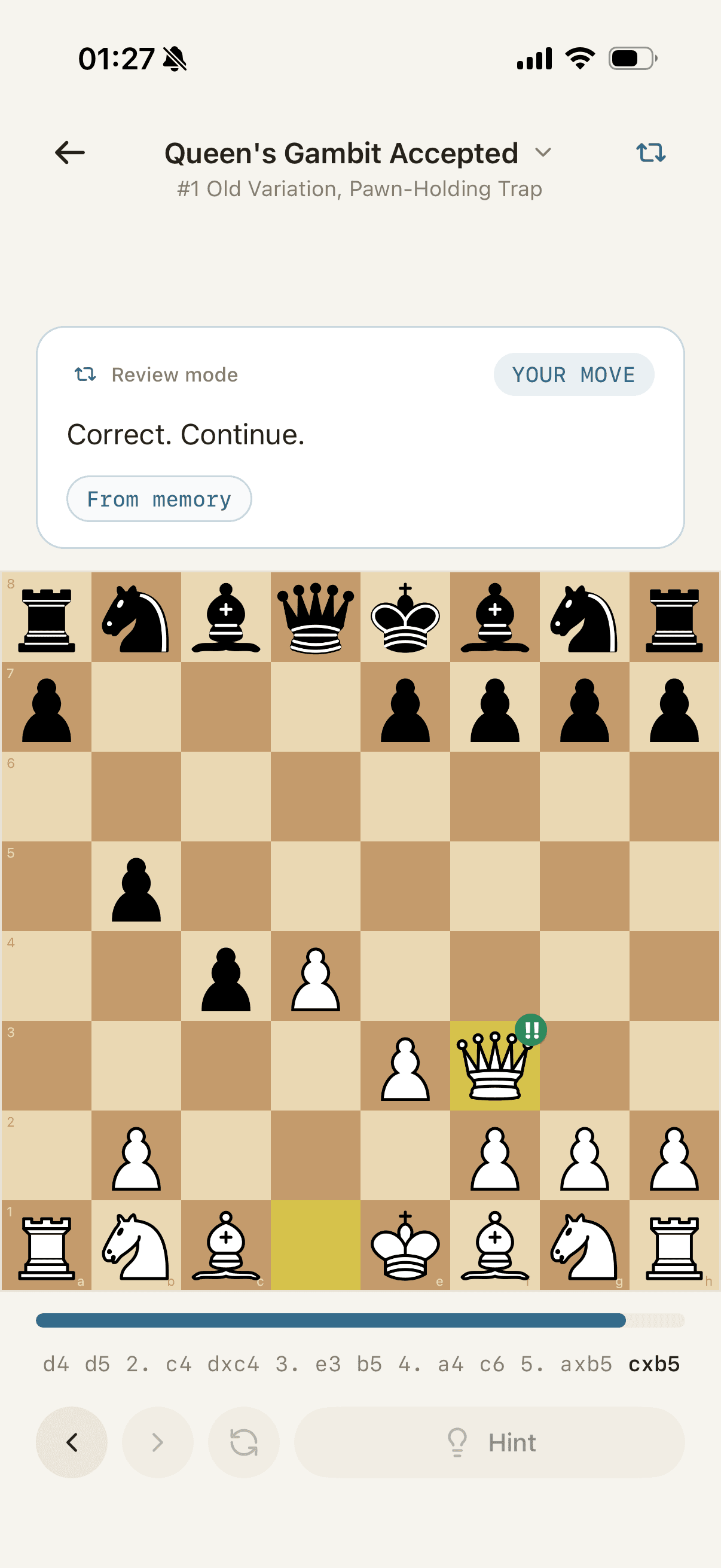
The Caro-Kann becomes easier to maintain when White's third move organizes the repertoire. Learn what ...c6 is preparing, separate the Advance from the capture structures, and add quieter branches after the center makes sense.
Master openings.
Learn curated lines, recall the move from the board, and keep useful positions fresh with spaced review.


Scan to get the app on your phone