Why you forget chess openings in real games
Diagnose why familiar chess opening lines disappear in real games and fix the part of your study method that is failing.
By Chessmate Team
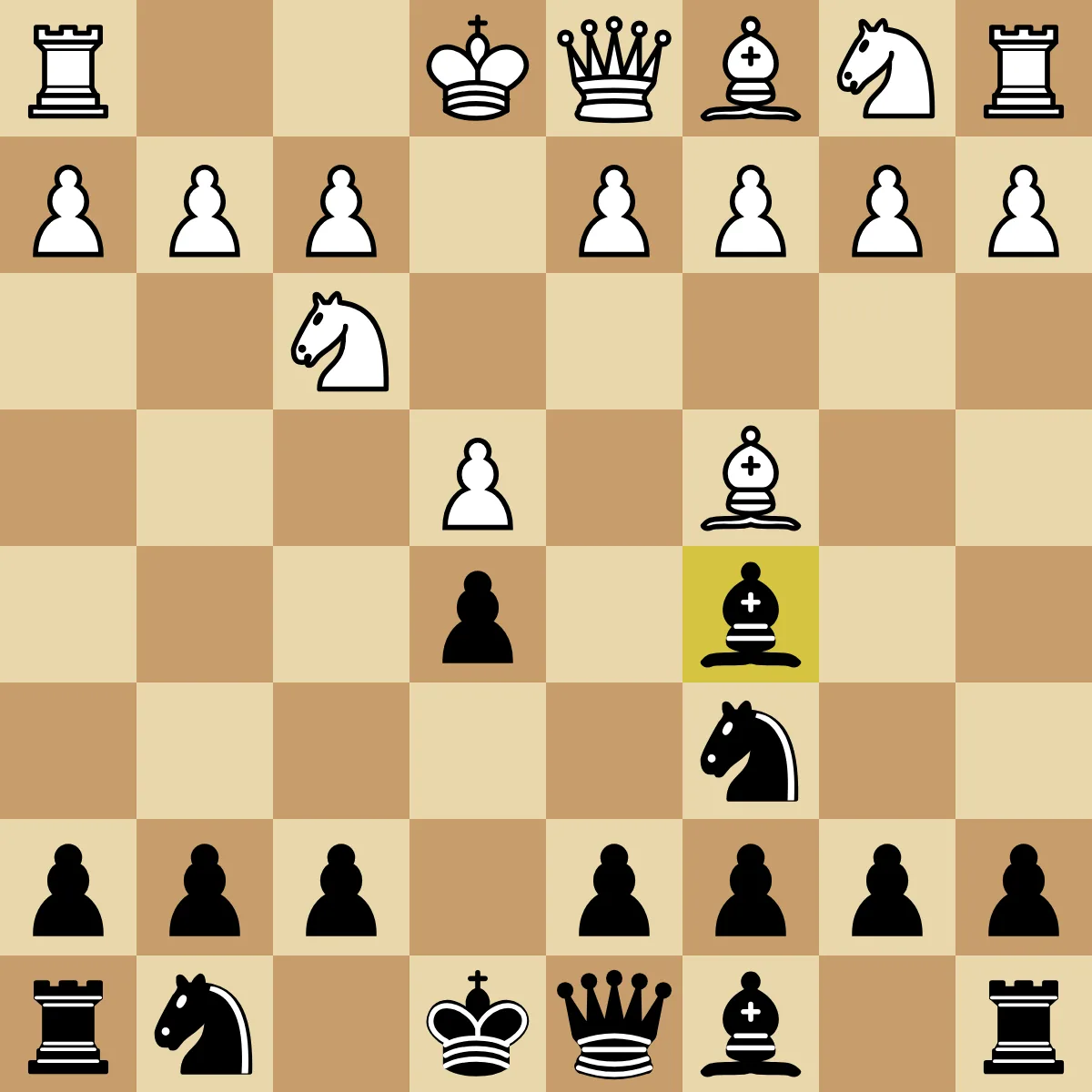
Position after 1.e4 e5 2.Nf3 Nc6 3.Bc4 Bc5.
You know the opening name, recognize the first moves, and still go blank when the familiar position reaches your board. That moment can feel like a memory problem, but several different practice failures can produce the same result.
The useful diagnosis depends on what you can do outside the game. Perhaps the line looks familiar only when the moves are visible. Perhaps two opponent replies blur together. Perhaps you can recite the notation but cannot find the move from the board. Each symptom points to a different correction.
Diagnose the failure mode before adding more theory or study time. Each symptom below has a smaller, more direct correction.
You recognize the line but cannot recall the move
Recognition means the answer feels familiar when you see it. Active recall asks you to produce the answer before it appears. Opening videos, annotated studies, and move lists can provide plenty of recognition without checking whether the board alone can prompt your response.
A multiple-choice answer can look obvious even when you could not write it on a blank page. The same gap appears in opening study. Seeing 4.c3 in an Italian line and thinking "yes, that is right" is easier than reaching the position after 3...Bc5 and choosing c3 without a hint.
Research on the testing effect has repeatedly compared additional study with attempted retrieval. In one 2006 experiment using prose passages, repeated recall produced better delayed retention than repeated study, although study increased confidence. The result is not direct evidence about chess, but it supports a practical check: try to produce the move before revealing it.
The smallest correction is one board prompt and one attempted move. Hide the continuation, stop after the opponent's reply, and play your response. A miss tells you which decision needs work.
Your study prompt does not match the game
A game presents a board position, not a chapter title or a visible PGN. If you learned the line mainly as notation, the cues available during study may be missing when your clock is running.
Tulving and Thomson's work on encoding specificity examined how retrieval depends on the relationship between stored information and available cues. Applying that idea to openings is an inference, not a chess-specific experimental result. It suggests a practical design choice: practice with the same kind of prompt the game will provide.
Use the board after the opponent's move as the prompt. Notice what changed, including a new attack, a pawn break, or a piece that blocks development. Then recall the course move from that position instead of reciting the line from move one every time.
Similar branches blur together
Nearby branches are easy to confuse when they share the same first moves. In the Italian Game, 3...Bc5 and 3...Nf6 look similar in notation, but one develops the bishop and the other attacks e4 with the knight.
Training both branches as one long list can hide the exact point where your response changes. You may remember c3, d3, or Ng5 from the course and still attach the move to the wrong Black setup.
Separate each branch at the opponent move that creates a new decision. Practice the position after 3...Bc5 on its own, then practice the position after 3...Nf6. A clear branch cue is more useful than another replay of the shared first three moves.
The move has no remembered reason
A move with no reason is harder to reconstruct after the exact notation fades. The reason does not need to explain the whole opening. It needs to identify the job your move performs in that position.
In the Caro-Kann Advance, Black often develops the light-squared bishop with ...Bf5 before playing ...e6. "Develop the bishop before the pawn blocks it" is enough to distinguish the order. If you remember only the two moves, reversing them can feel harmless until the bishop loses its route.
Understanding supports recall, while tactical positions still demand exact calculation and move order. A short reason gives you a retrieval cue and a way to continue when preparation ends.
The repetitions happened too close together
Immediate replays can make a line feel stable because the previous attempt is still fresh. Four successful runs on Saturday do not show whether the same moves will return in a game on Thursday.
Research on distributed practice has found broad benefits from separating study events across time, while also showing that no single interval is best for every retention goal. The Cepeda et al. review covered many verbal-learning experiments rather than chess openings, so the application should remain modest.
Bring new or missed positions back sooner, then lengthen the delay after successful recall. Spaced repetition schedules that return. The recall attempt during the review remains a separate part of the practice.
You trained more branches than you can maintain
Every added branch creates future review work. A rare sideline may be interesting, but it competes for time with the positions that decide your actual games.
An oversized queue also makes similar moves harder to separate. If you study three answers to the same opponent move in one sitting, you may remember all three candidate moves without remembering which course choice belongs to the board.
Reduce the set to the main line and the replies you have faced. Add a branch when it appears repeatedly, causes the same early loss, or reaches a position where you have no plan. Our guide to practicing chess openings online explains that selection process in detail.
Diagnose the blank moment
Each symptom points toward a specific correction.
- If the answer looks familiar only after it appears, attempt recall before revealing it.
- If you can recite notation but freeze at the board, practice from the position after the opponent's move.
- If two variations trade places in your head, separate them at their first meaningful branch.
- If the move disappears with no way to reconstruct it, attach one short reason.
- If the line works today and vanishes next week, review it after a delay.
- If the queue keeps growing, remove branches that have not earned their review cost.
Fix one failure mode before rebuilding the whole repertoire. The right correction may be one board prompt, one explanation, or one later review.
How Chessmate exposes the gap
Disclosure: Chessmate is our product. The diagnostic ideas above also apply to other trainers and study methods.
Chessmate separates Study, Review, and Challenge because those modes reveal different information. Study shows the course move and its explanation. Review brings a trained position back later. Challenge removes the teaching support and asks you to play the move.
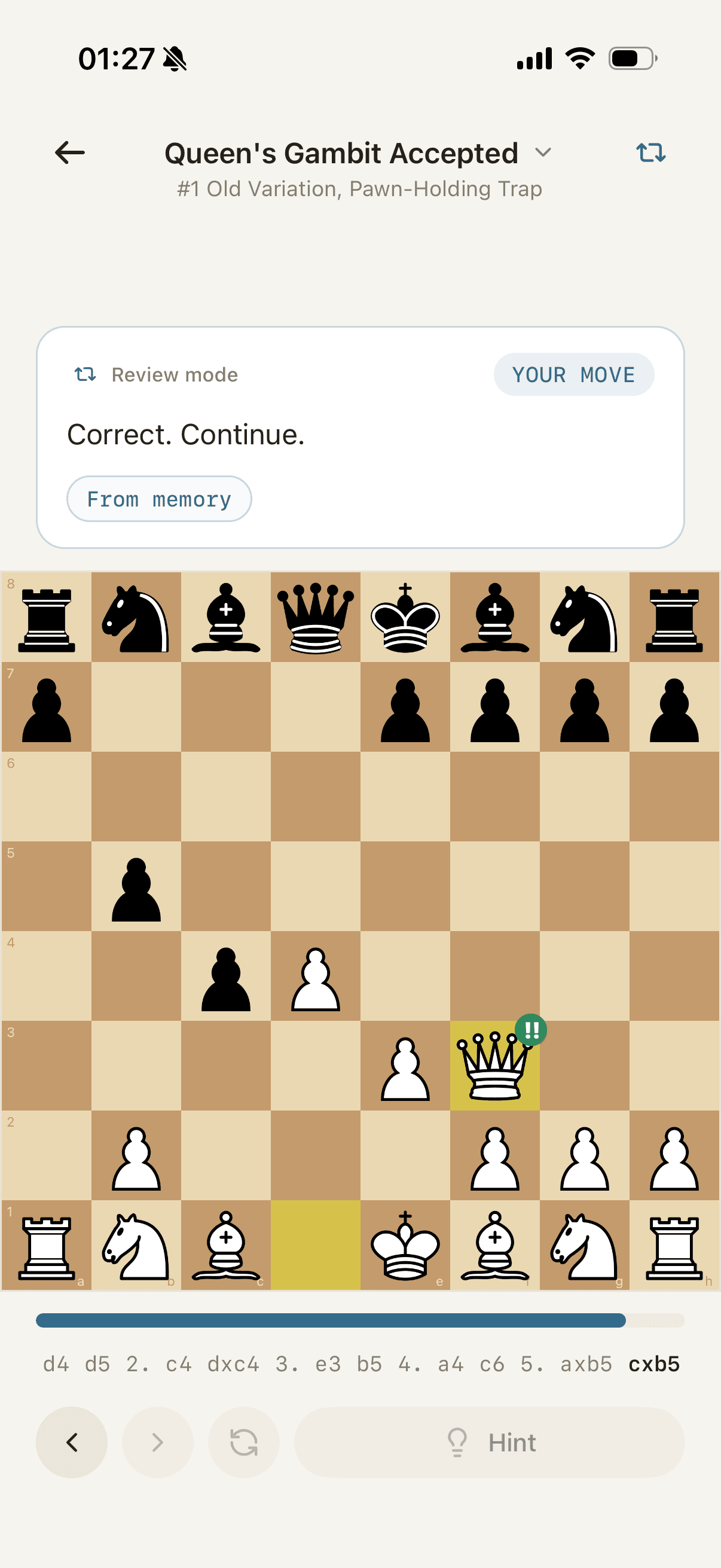
A miss in Challenge identifies a position that still depends on teaching support. Return to that decision, check the reason, and test it again later.
Name the failure before changing your practice. Check whether the problem is recognition, the prompt, the branch, the reason, the timing, or the size of the repertoire. Then change the smallest part that addresses it.
References
Roediger and Karpicke (2006), Test-enhanced learning; Tulving and Thomson (1973), Encoding specificity and retrieval processes; Cepeda et al. (2006), Distributed practice.
Master openings.
Learn curated lines, recall the move from the board, and keep useful positions fresh with spaced review.