What to play after your memorized opening line ends
Forgot what comes after your opening? Compare two candidate moves in Queen's Gambit and French positions, with a five-question checklist and review notes.
By Chessmate Team
When memory stops, the position still contains useful clues.
Your memorized line does not end at the same point as the opening. It ends when the next move no longer comes with a reason you trust.
That moment is normal. Even a large repertoire eventually reaches a position you have not stored. The goal of opening study is not to postpone independent chess forever. It is to arrive at the handoff with development, king safety, and a structure you understand.
When memory stops, use five questions.
1. What did the opponent's last move change?
Do not begin with “What was my line?” Begin with the move on the board.
Did it:
- attack a piece or pawn?
- open a file, rank, or diagonal?
- weaken a square?
- prepare a pawn break?
- prevent your intended move?
A move outside your preparation is not automatically bad. It may be quiet, tactical, or simply a different route into a familiar structure. Treat it as evidence, not an insult to your memory.
If there is a direct threat, answer it. Opening principles do not excuse hanging material.
2. Which side is behind in development or king safety?
Count the pieces doing useful work, not pieces that have merely left their starting squares.
If your king is still in the center and castling is safe, finishing that task may be more urgent than starting a pawn attack. If your opponent has moved the same piece several times, a developing move with tempo may preserve the advantage without requiring a tactic.
Avoid automatic castling. Check the destination first. “Castle early” is a default, not a substitute for looking at the board.
3. What does the pawn structure ask for?
Pawns tell you which plans are plausible.
Look for:
- a central pawn that can be challenged
- a backward or isolated pawn that can become a target
- a pawn chain and its base
- an open file created by an exchange
- a break such as
c4,c5,e4, ore5
In a Queen's Gambit Declined structure, White may build pressure on d5 and prepare a central break. In the Accepted, Black's d-pawn has moved from d5 to c4, changing both space and development. The opening name is shared, but the structure gives different instructions.
4. Which piece has no future yet?
When there is no immediate tactic, improve the least useful piece.
Ask where it would contribute to the central plan. A rook may need an open file. A blocked bishop may need a pawn break or a different diagonal. A knight on the rim may need a route back toward the center.
This question is more precise than “develop a piece.” It connects development to a job.
5. What are my two sensible candidates?
Choose two moves that answer the position. Compare them for:
- tactical safety
- effect on the center
- king safety
- the opponent's strongest reply
- whether the move is easy to follow up
You do not need to discover the engine's first choice to continue a healthy opening. A playable move with a coherent reason is the immediate goal.
A worked handoff from theory
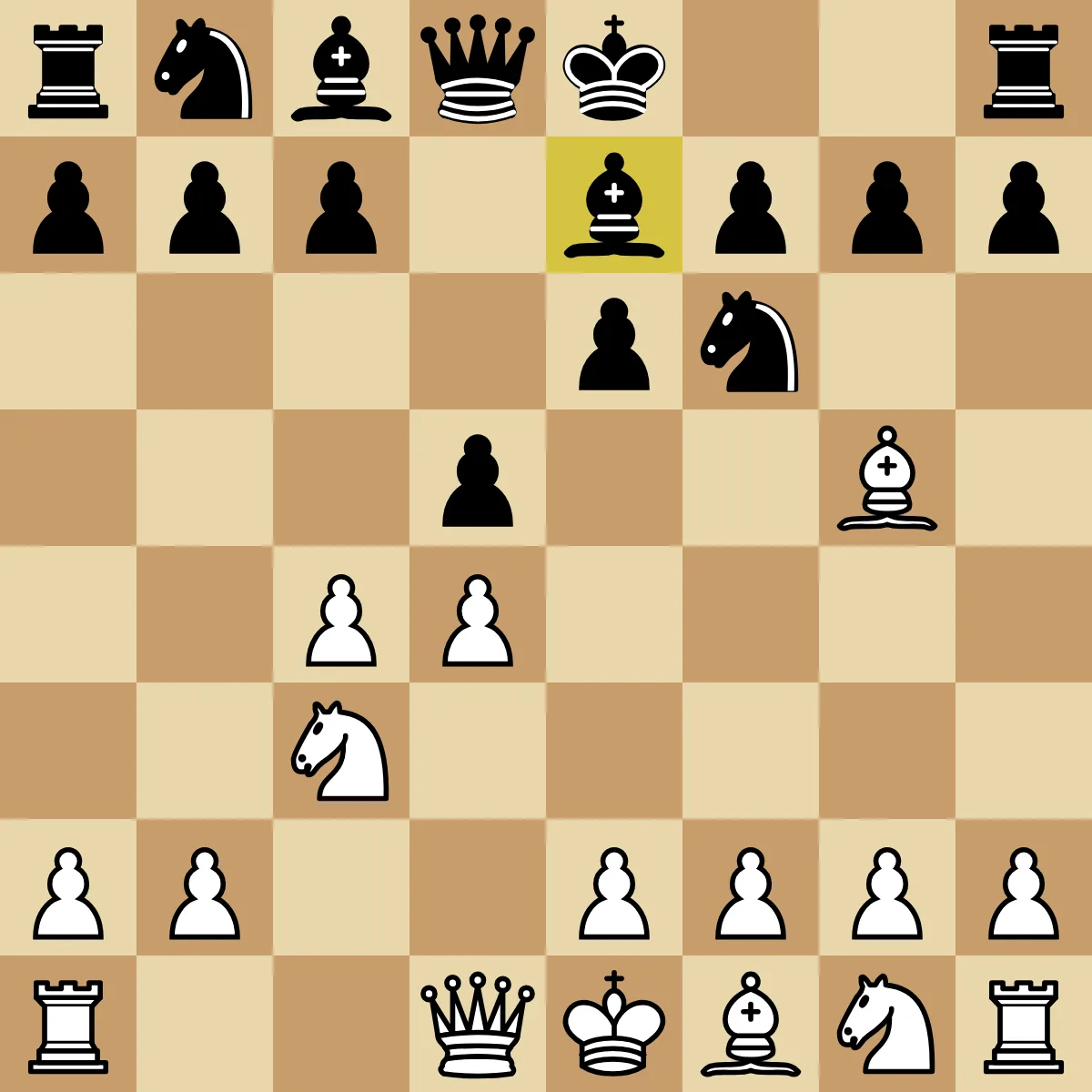
Imagine you prepared a Queen's Gambit line through 1.d4 d5 2.c4 e6 3.Nc3 Nf6 4.Bg5 Be7, then forget the next move.
The board gives you a usable reconstruction:
- there is no direct threat demanding a response
- both kings still need safety
- Black's d5 pawn is supported by e6
- White can continue development and prepare a central decision
e3andNf3are sensible candidates with clear purposes
You may not recall the exact order. You can still avoid a random pawn move because the structure narrows the task.
If order matters tactically, note the position after the game and study it. During the game, calculate the candidates in front of you.
Follow a candidate far enough to see its job
In the Queen's Gambit position above, compare 5.e3 O-O 6.Nf3 with 5.Nf3 O-O 6.e3. These illustrative continuations reach the same position. e3 frees the f1 bishop and supports d4; Nf3 develops a knight and supports d4. Your next task is to develop the bishop and check whether castling is safe. This does not mean the move orders are interchangeable against every Black response.
Now set up a different center: 1.e4 e6 2.d4 d5 3.e5 c5 4.c3 Nc6. White's d4 pawn is attacked by the c5 pawn and c6 knight. 5.Nf3 develops and adds a defender to d4. 5.Be3 also defends d4, but commits the c1 bishop before developing the g1 knight. Compare those concrete jobs rather than copying the previous example's e3, which is no longer legal: White's e-pawn stands on e5.
One possible continuation is 5.Nf3 Qb6 6.Be2 cxd4 7.cxd4. After ...Qb6, notice pressure on d4 and b2. After the pawn exchange, White's c-pawn has replaced the d-pawn on d4. The position has changed; a remembered instruction to support d4 with c3 no longer describes the board. These are legal teaching continuations, not forced lines or engine rankings.
| Game note | Queen's Gambit example | French example |
|---|---|---|
| What needs attention? | Develop f1 bishop and g1 knight | Pressure on d4 |
| My candidates | e3, Nf3 | Nf3, Be3 |
| What changed after the reply? | Black castled | ...Qb6 adds pressure; later ...cxd4 changes the structure |
| What should I save? | A development plan if the choice was sound | A note about d4 and the recapture, if I missed them |
Try Nf3 or Be3 and compare how each defends d4. Reset to try the other candidate.
Try Nf3 or Be3 and compare how each defends d4. Reset to try the other candidate.
Use the Queen's Gambit or French Defense guide for the relevant structure. Rehearse one handoff in an opening you actually play, then write your own two candidates before checking the continuation.
Spend the remaining time on the position
Players often burn time trying to retrieve a vanished move. Set a limit. If the line does not return after one calm scan of the board, move to the five questions.
This protects both time and confidence. Forgetting theory is information about preparation, not proof that the position is bad.
The earlier guide on what to do when an opponent leaves your line covers unexpected deviations. Here, the handoff can happen even in a main line simply because your preparation has reached its boundary.
Review the decision, not only the database verdict
After the game:
- write the candidates you considered
- state what you thought the position required
- check the opening source or explorer
- analyze tactical errors separately
- decide whether to add a line, a plan note, or nothing
An explorer can show that a move is common. It cannot tell you whether your thought process was healthy. The Lichess opening explorer is useful for locating the branch, while your game notes explain why it mattered.
Add a branch if the position is common and the choice is concrete. Add a plan note if several moves are playable but you missed the structure. Add nothing if your move was reasonable and the later mistake was unrelated.
Train the handoff on purpose
During practice, stop a line one move earlier than usual and hide the continuation. Use the five questions to select a candidate. Then compare your choice with the course explanation or trusted source.
This is not a test of perfect recall. It is practice at leaving the map without losing direction.
Chessmate teaches curated lines and asks for recalled moves in Review and Challenge. Disclosure: Chessmate is our product. No trainer can contain every future position. A good one should help you recognize the structure when the stored answer is over.
Theory should deliver you to a playable position. From there, the board takes over.
Sources
Master openings.
Learn curated lines, recall the move from the board, and keep useful positions fresh with spaced review.