
How spaced repetition works for chess openings
Learn what spaced repetition is, what the research supports, and how to use review intervals to remember chess openings for longer.
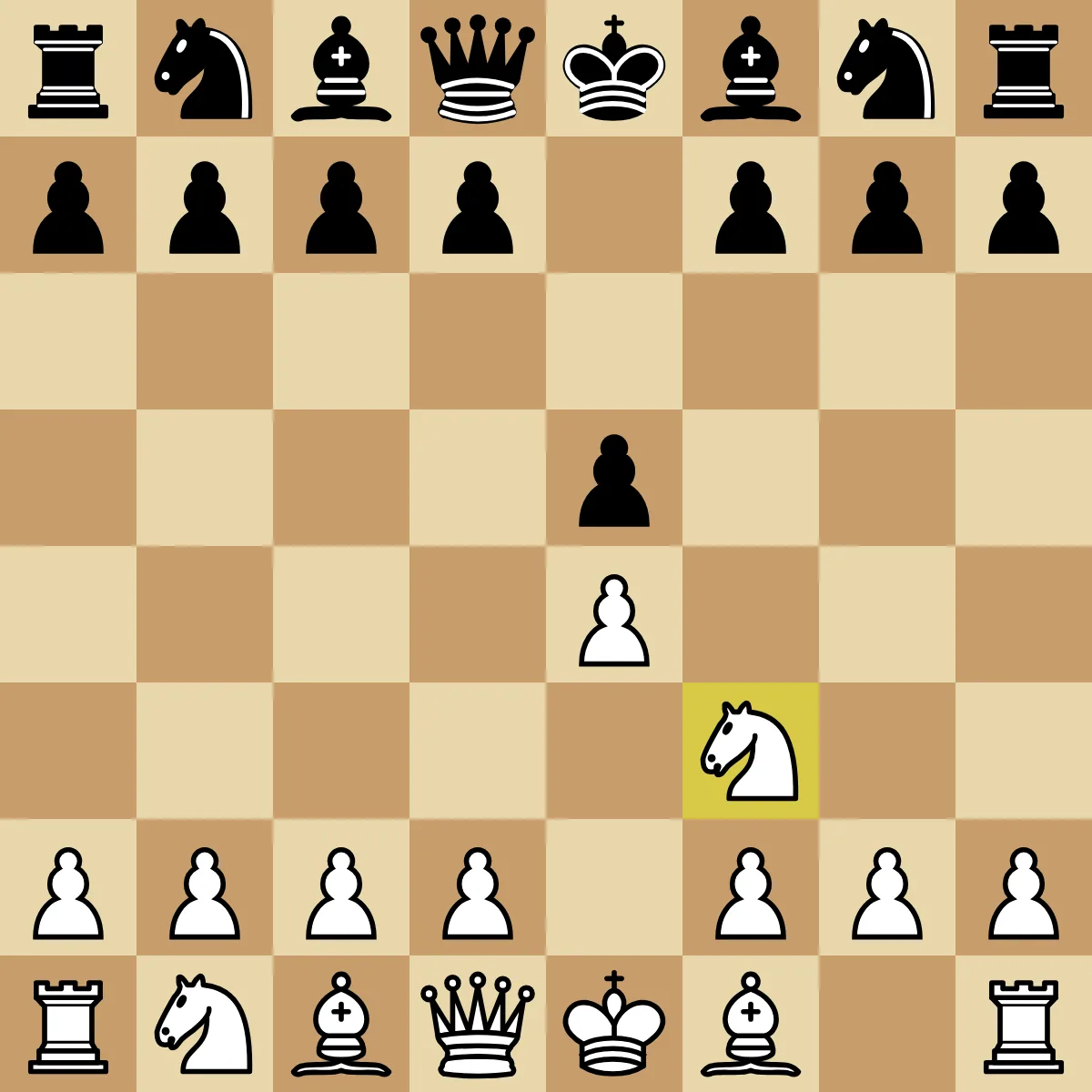
Position after 1.e4 e5 2.Nf3.
Four repetitions of the same chess opening on Saturday can create a strong sense of familiarity, then leave you blank by Thursday. The session may have been too compressed.
Review timing matters because an opening line may not appear in a real game for days or weeks. Research on many kinds of learning supports spaced practice, though direct evidence for chess openings is limited. A schedule manages when a line returns; choosing useful lines and recalling moves are separate parts of practice.
What is spaced repetition?
Spaced repetition is a way of distributing review across time. Instead of exhausting one line in a single session, you revisit it after a delay. New or unstable material returns sooner. Material that has remained available across several reviews can wait longer.
Researchers call review spread across time distributed practice and compare it with massed practice.
Massed practice groups repetitions together. A pianist does this when they play the same difficult bar twenty times in one sitting. The previous attempt is still fresh when the next one begins. Replaying one opening line again and again in the same session works the same way. Distributed practice separates those encounters with other material or with time. A spaced-repetition system turns that principle into a schedule.
A simple system might work like this:
- A newly learned item returns after a short delay.
- A missed item returns sooner.
- A successful item receives a longer interval.
- Continued success stretches the interval further.
The rules differ between systems. Some use fixed boxes or interval multipliers. Others estimate how stable each memory is. They all try to avoid spending the same amount of review time on every item.
Spacing and retrieval are different decisions
Spaced repetition and retrieval practice are often bundled together in learning apps. They solve different problems.
- Spaced repetition asks when the material should return.
- Retrieval practice asks what the learner should do when it returns.
Looking at an answer again can be spaced. Trying to produce the answer from memory can be spaced too. The second activity adds retrieval practice, but spacing itself refers to the timing.
A study that sends quizzes every two weeks combines a schedule with testing and feedback. If the group later remembers more, the entire result cannot automatically be credited to the spacing algorithm alone.
In practical learning systems, the two techniques often work well together. They still deserve separate explanations.
Why cramming can feel more effective than it is
Massed practice has an immediate advantage: the material is still active. The next repetition feels smooth, and smooth performance is easy to mistake for durable learning.
A delayed review is less comfortable. Some details have faded. Reconstructing the earlier learning takes more work, and sometimes it fails. That weaker performance during practice can make the method feel inefficient even when later retention is better.
Researchers have proposed several explanations for the spacing effect. An immediate repetition may receive less attention because the item already feels available. A delayed encounter may require the earlier learning to be accessed again. Encounters in different contexts may also create more routes back to the material. Kang's review discusses these possibilities without settling on one mechanism. A single universal "forgetting curve" cannot describe every case. Memory changes with the learner, the material, the review activity, and the time until the final test.
Ease during a study session can be a poor guide to what will remain accessible days or months later.
What the research says about spacing
In a major 2006 review, Nicholas Cepeda and colleagues analyzed 839 assessments from 317 experiments across 184 articles. The studies covered several kinds of verbal learning and compared massed with spaced learning episodes. Across that literature, the timing between study events mattered for later retention.
Longer gaps did not win in every condition. The interval between study sessions interacted with the desired retention interval. If the final test was further away, the most useful study gap tended to be longer too.
A later experiment made that relationship easier to see. More than 1,350 people learned facts, reviewed them after gaps ranging up to 3.5 months, and took a final test as much as a year later. The gap associated with the strongest retention changed with the final-test delay. A review schedule optimized for next week should not be assumed to be optimal for next year.
Sean Kang's review of the field similarly concludes that spaced encounters generally produce better long-term learning than massed repetitions. It also notes that tests can amplify the benefit of spaced practice. Again, that is a combination of spacing and retrieval rather than proof that they are one mechanism.
The evidence supports distributing learning across time. It does not prescribe one mandatory sequence such as one day, three days, seven days, and thirty days for every learner.
What spaced repetition looks like outside the laboratory
Real learning systems rarely isolate spacing as neatly as a laboratory experiment. They combine repeated exposure, questions, feedback, and adaptive scheduling. That makes them useful examples, as long as we are precise about what was tested.
Medical education
A 2026 systematic review and meta-analysis examined spaced-repetition interventions in medical education. The included methods ranged from flashcards and emailed multiple-choice questions to spaced classroom quizzes. Across 13 studies in the meta-analysis, covering 21,415 learners, spaced-repetition interventions outperformed standard study approaches on objective tests. The authors also called for more work on optimal design and longer-term professional outcomes.
One especially large study followed 26,258 family physicians and residents. Participants received case-based questions repeated across calendar quarters, while a control group received no spaced repetition. The spaced groups performed better on later repeated concepts and on rewritten questions designed to test transfer. Repeating questions twice also outperformed repeating them once. Within the single- and double-repetition groups, the different timing schedules did not produce meaningful differences.
These studies show that distributed review can work in serious professional learning without establishing one correct interval for every consumer app.
Language learning at scale
Duolingo researchers presented a model that estimated the "half-life" of a word or concept in a learner's memory and used that estimate to predict recall. In their published system study, the model reduced recall-prediction error by more than 45% against several baselines and improved daily engagement in an operational experiment.
The study is a useful example of adaptive scheduling at scale, but its metrics need careful reading. Recall prediction and engagement are product outcomes. Neither one measures permanent language mastery.
There is no single perfect review interval
"Review it just before you forget" is a memorable description of spaced repetition. A learning system cannot observe that exact moment directly.
A scheduler can estimate recall from previous answers, elapsed time, and a model of memory. That estimate will always have uncertainty. The same learner may remember a move differently depending on the surrounding line, the board orientation, recent games, fatigue, and how well the position was understood in the first place.
A useful spaced-repetition system makes an estimate, schedules the next review, then updates the estimate from later performance.
The target also matters. Preparing material for tomorrow permits a different review interval from maintaining it for a season. Cepeda's long-duration study is especially important here: the best interval depends partly on how long the knowledge needs to last.
Applying spaced repetition to chess openings
The studies above cover broader memory and educational tasks rather than chess opening repertoires. Applying their findings to opening review is a reasonable inference, not direct proof that a particular chess trainer or schedule will work for everyone.
An opening repertoire does have the kind of retention problem spacing is designed to address. You may learn a line today and not face it in a game for two weeks. If you review every line every day, the workload grows faster than the repertoire. If you never review, less familiar branches fade.
The scheduler handles timing. You still need to choose practical lines, understand why the moves work, and remove rare branches. Spacing works best when each review item is clear, mistakes receive useful feedback, and the queue stays manageable.
A basic opening schedule can work as follows:
- Learn a small, practical opening line.
- Bring it back after a delay instead of replaying it ten times immediately.
- Return weak or forgotten material sooner.
- Let stable material wait longer.
- Remove branches that are not useful enough to justify their review cost.
What happens during each review is a separate design choice. A trainer may show the line again, ask a question, or require the learner to play a move. Those activities involve different amounts of retrieval practice even when the timing stays the same.
A review queue tells you which material needs attention today. It keeps you from drilling the newest line until it feels familiar or restarting the entire repertoire whenever you sit down.
Scheduling only helps after you choose useful material. Start from a curated set of lines or a carefully chosen repertoire, learn what the moves are trying to achieve, and use spacing to maintain that knowledge without treating every branch as equally urgent.
If you are building the opening routine itself, our guide to practicing chess openings online explains how to choose a useful line, keep branches under control, and connect review to positions you face in games.
How Chessmate uses spaced review
Disclosure: Chessmate is our product. The research above does not validate Chessmate specifically, and the principles apply to other learning tools too.
Chessmate uses spaced review inside a focused opening-training loop. Learners study curated lines with explanations, and trained positions return for later review instead of requiring the whole course to be replayed every day. The goal is practical: spend more attention on material that is due and less on moves that are already stable.
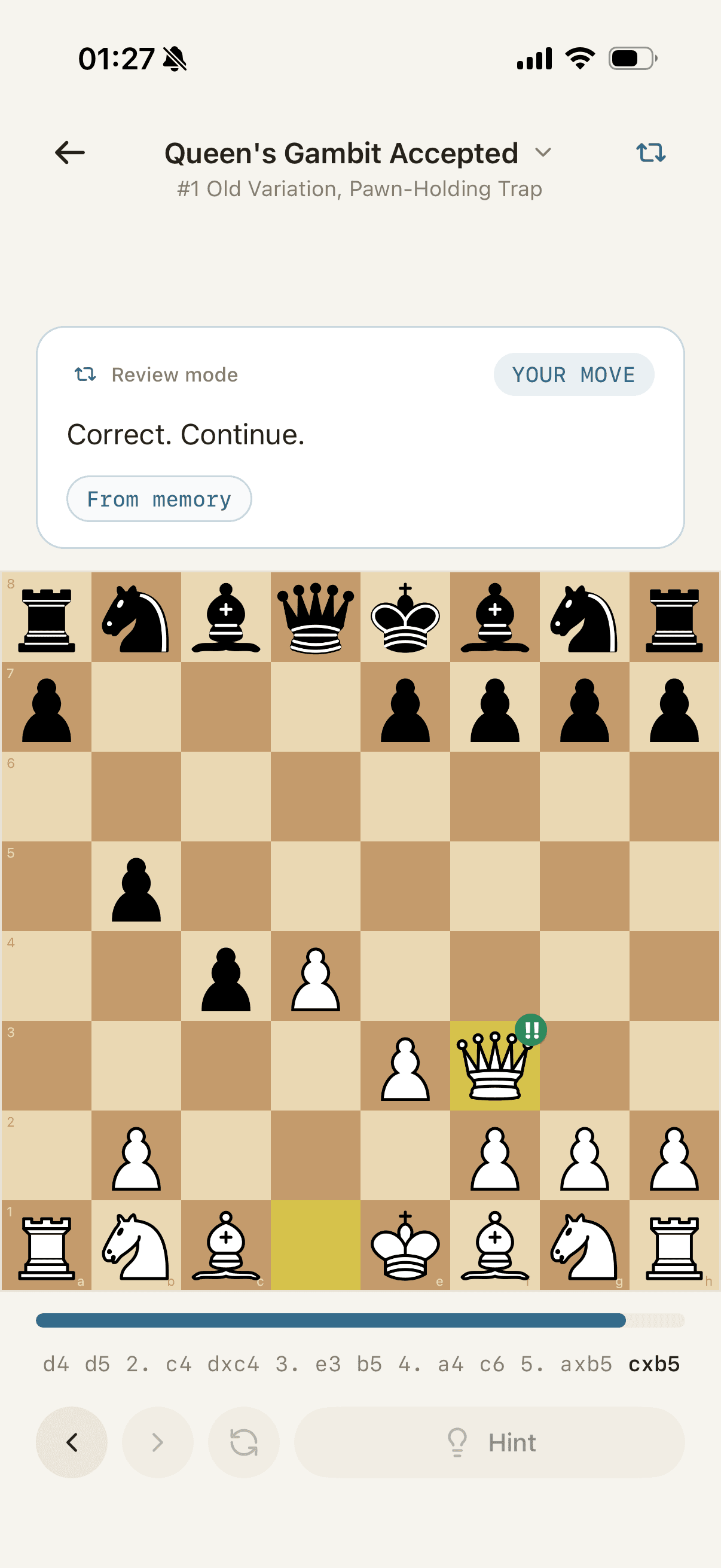
Chessmate separates the work across Study, Review, and Challenge. Study supplies the line and its explanation. Review brings trained material back later. Challenge checks whether the moves remain available.
What spacing can do for opening practice
A large body of research supports distributing practice across time when the goal is long-term retention. Spaced repetition turns that principle into a review schedule that changes as the learner answers.
For chess openings, that can mean fewer immediate replays and a smaller queue built from lines worth remembering. Opening choice, explanation, and broader chess improvement still require other kinds of work. Spaced review has a narrower job: keeping useful opening knowledge available until you meet it again.
Frequently asked questions
What is spaced repetition?
Spaced repetition schedules repeated study across time instead of grouping every repetition into one session. New or unstable material tends to return sooner, while material that remains available can receive longer intervals.
Is spaced repetition the same as active recall?
Spaced repetition and active recall solve different problems. Spaced repetition determines when material returns. Retrieval practice, often called active recall, determines whether you try to produce the answer from memory when it returns. Many learning systems combine them.
Does spaced repetition work for chess openings?
The spacing effect is strongly supported across memory and educational research, but direct controlled evidence for chess openings is limited. Applying it to opening lines is reasonable when the material is practical, the reviews are clear, and the queue stays small enough to maintain.
How often should you review a chess opening?
There is no universal interval. A new or forgotten line should return sooner, and a stable line can wait longer. The useful gap also depends on how long you want to retain the material.
References
Cepeda et al. (2006), Distributed Practice; Cepeda et al. (2008), Spacing Effects in Learning; Kang (2016), Spaced Repetition and Learning; Maye and Hurley (2026), Spaced Repetition in Medical Education; Price et al. (2025), Spaced Repetition in Practicing Physicians; Settles and Meeder (2016), A Trainable Spaced Repetition Model.
Master openings.
Learn curated lines, recall the move from the board, and keep useful positions fresh with spaced review.


Scan to get the app on your phone