Chess opening app vs book: choose for understanding or recall
Compare paper, interactive ebooks, and opening trainers. Try a book-to-board exercise to see whether you need better explanations or better recall practice.
By Chessmate Team
The best format depends on whether you need explanation, exploration, or recall practice.
An opening book and an opening app are not the same lesson in different containers. They make different actions easy.
A book is good at building an argument across pages: why an opening works, how plans develop, and what model games reveal. An app can place the current position in front of you, hide the answer, and bring the same decision back later.
Choose by the work you need to do.
Where an opening book is strongest
A good book can provide:
- an author's coherent repertoire choices
- detailed explanations of pawn structures and plans
- annotated model games that continue past the opening
- alternatives and historical context
- a stable reference you can mark and revisit
Books are especially valuable when your problem is not “What move goes here?” but “What kind of position am I trying to play?” A full annotated game can show how an opening decision shapes the middlegame.
The limitation is interaction. If the answer is visible on the page, it is easy to mistake recognition for recall. You can solve this with a board: set up the position, cover the moves, choose your answer, then read.
Where an opening app is strongest
An app can reduce the friction of:
- setting up each board position
- trying a move before seeing the answer
- jumping directly to a branch point
- tracking weak positions
- scheduling later reviews
- practicing on a phone in short sessions
Those are workflow advantages, not proof that every app teaches well. Some apps are databases with little explanation. Others test moves without giving enough context. Compare what the tool asks you to do.
The opening-trainer app comparison evaluates current tools by practice style. Product details change, so verify features and prices near your decision.
The key question: does the answer stay hidden?
Whether you use paper or software, memory practice begins when you must produce a move without seeing it.
Roediger and Karpicke compared repeated study with repeated retrieval for prose passages and found an advantage for retrieval on delayed tests. This is not a direct comparison of chess apps and books, and it does not prove that an app improves chess. It does show why format alone is the wrong comparison: the learning action matters. See the study on PubMed.
A book used with a covered page and physical board can support retrieval. An app that constantly reveals arrows may not.
Compare the formats by six jobs
| Learning job | Print book + board | App |
|---|---|---|
| Deep explanation | Often excellent | Varies widely |
| Model games | Natural format | Available in some tools |
| Position setup | Manual | Usually immediate |
| Recall prompt | Requires deliberate setup | Can be built into the flow |
| Spaced review | Manual schedule | Can be automated |
| Broad browsing | Slow but coherent | Fast, sometimes distracting |
No column wins every row.
When a book is the better first purchase
Choose a book first if:
- you want one expert's complete repertoire argument
- you enjoy long-form study and annotated games
- your main gap is understanding typical middlegames
- you already have a reliable way to practice positions
- you want a reference that does not depend on a subscription or device
Before buying, check the intended rating, publication date, notation format, and whether the repertoire matches your side.
When an app is the better first tool
Choose an app first if:
- you already know roughly what you want to play
- your main problem is forgetting moves in games
- you study in short sessions
- setting up boards manually prevents practice
- you need weak positions to return automatically
Test the onboarding and a real line before importing a large repertoire. A smooth interface is not enough if explanations are thin or review prompts do not match the board you see in play.
Check a real sample before buying
The official sample of John Emms's First Steps: 1 e4 e5 includes explanations, diagrams, and an exercise with its answer. It illustrates why a book can support active study: you can pause and solve before reading on. We reviewed the public sample, not the complete book or a paid edition. It is an example of format, not a claim that it is the best purchase for every repertoire.
An interactive ebook adds automatic position setup to a book's text. That alone does not establish that it hides answers, schedules review, or lets you enter a personal repertoire. Check those tasks individually in the edition and device you will use. A print book plus board can still meet your needs if manual setup does not stop you practicing.
Try the same learning task in either format
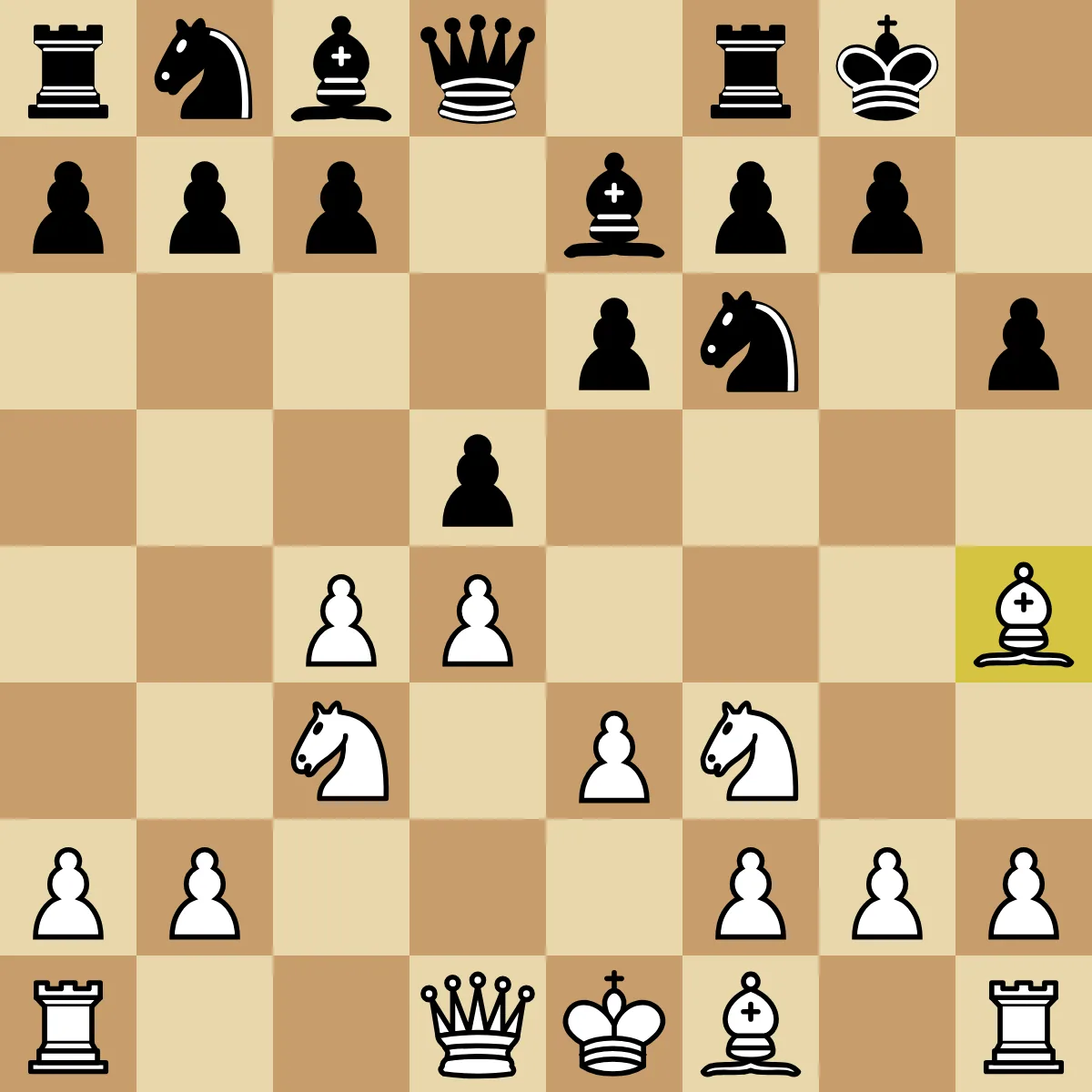
This is our own short exercise, not an extract from that book. Set up 1.d4 d5 2.c4 e6. Before reading further, choose a developing move and explain how it relates to the center.
One answer is 3.Nc3: the knight develops, attacks d5, and supports e4. A possible continuation is 3...Nf6 4.Bg5 Be7 5.e3. Stop there and explain what e3 makes possible for the f1 bishop. These moves illustrate a learning task, not a forced sequence.
| Try this | Paper or ebook | Recall trainer |
|---|---|---|
| Find the position | Set it up on a board, or tap the ebook's notation if supported | Open a matching line, or enter your own only if supported |
| Produce a move | Cover the next move and its explanation | Hide the continuation and hints |
| Explain the reason | Say what changed on d5 and e4 before reading | Compare your reason with the explanation, not just a correct-move indicator |
| Return later | Mark the page and note a review date | Verify that the position returns in the review flow |
Record move recalled? reason explained? setup manageable? If you recall Nc3 but cannot explain it, you need more explanation or a model game. If you can explain it while reading but cannot find it later, add hidden-answer practice. If setup prevents the second session, an interactive format may help. No purchase is necessary to run the paper-and-board version.
Use the Queen's Gambit guide to explore the structure, or the trainer comparison after you know which task needs support.
Transfer only the positions you need
Use the book for depth and the app for retrieval:
- read one chapter or model game
- write the central plan in your own words
- extract one main line and one common alternative
- enter or select only those positions in the app
- attempt moves from the board over several sessions
- return to the book when a plan remains unclear
Do not import every variation before you have played the opening. Let your games decide which branches deserve transfer.
What Chessmate does and does not replace
Chessmate provides curated opening lines, concise explanations beside the board, and Study, Review, and Challenge modes. Disclosure: Chessmate is our product.
It is designed as a focused trainer, not a replacement for every annotated opening book or a complete game database. If you want a long author's repertoire and dozens of model games, a book can add depth. If you need to turn a small set of useful positions into answers you can recall, a trainer removes friction.
The better format is the one that closes your current gap. For many players, the best answer is not app or book. It is book for the map, app for the next move.
Sources
Master openings.
Learn curated lines, recall the move from the board, and keep useful positions fresh with spaced review.