Best chess openings for beginners who play online
Compare practical chess openings for beginners and choose a manageable first option for White, Black, and common online positions.
By Chessmate Team · Updated October 9, 2026
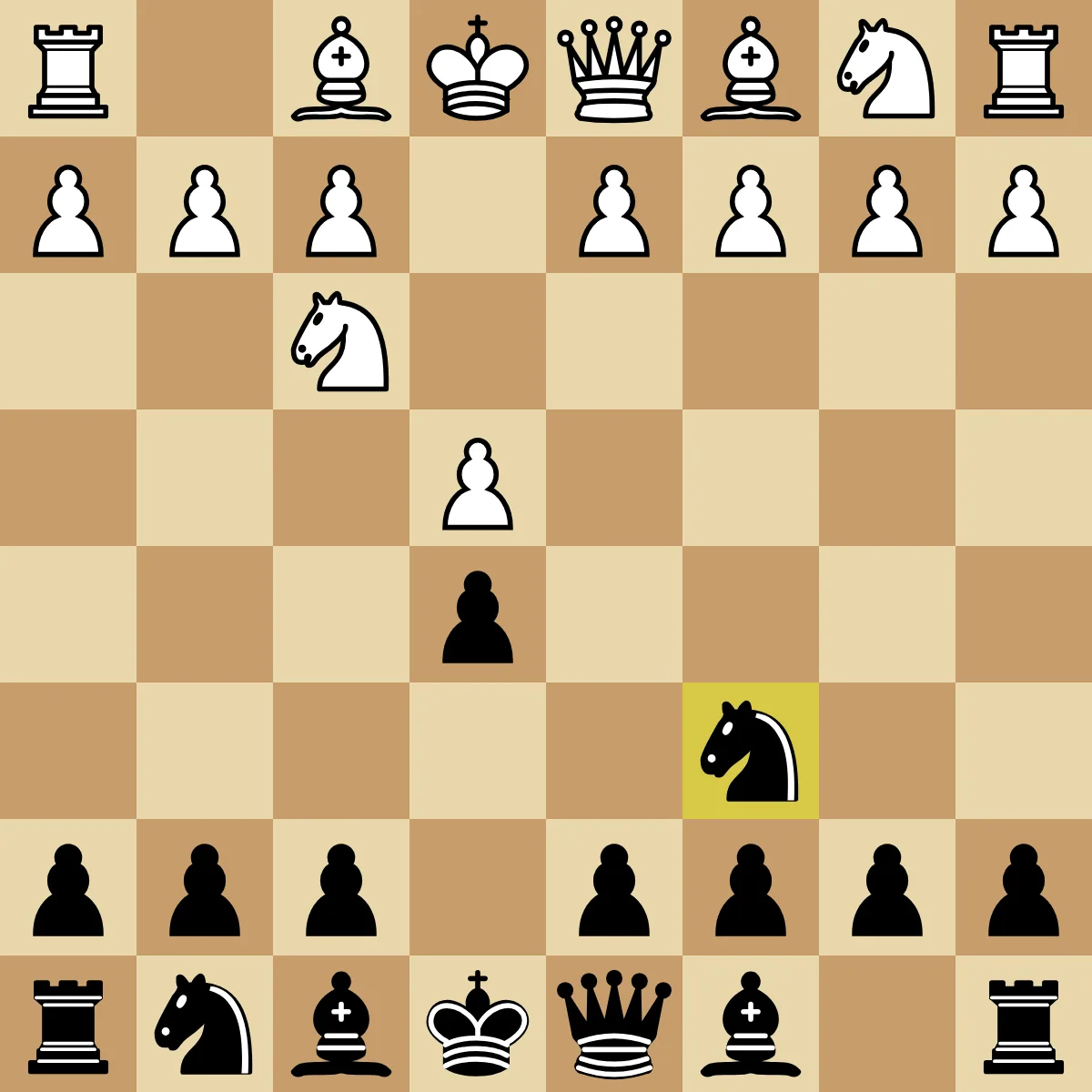
Position after 1.e4 e5 2.Nf3 Nc6.
A useful beginner opening appears often enough for you to recognize its positions and understand its plans. A trap that works once will not help much when an opponent plays a quiet developing move instead. A huge opening repertoire has the opposite problem: you spend more time sorting lines than learning any one of them.
For a beginner-to-intermediate online player, a sensible starting set is small. Choose one opening with White, one response to 1.e4, and a basic plan against 1.d4. Learn the first important branch in each, then add material when your games give you a reason.
If you want a direct recommendation, start with the Italian Game as White and the Caro-Kann against 1.e4. Meet 1.d4 with 1...d5, learning the Queen's Gambit Declined when White follows with 2.c4. The other choices below are useful when those positions do not suit you. For a recommendation matched to your rating and playing style, take the opening quiz.
What makes an opening good for beginners?
A beginner-friendly opening should make the first few decisions easier to understand. That usually means the moves develop pieces, contest the center, or prepare king safety in a visible way. The opening should also lead to positions you can meet again without requiring a new answer to every legal reply.
Four checks are useful when comparing openings:
- Can you explain the job of the first few moves?
- Do the same pawn structures and piece placements return across different games?
- Can you begin with one short line and add branches later?
- Does the opening leave you with a plan when the memorized moves end?
"Easy" does not mean playing the same setup regardless of the opponent. Even a quiet system can go wrong if you ignore a central break or an attack on a loose piece. A manageable opening reduces the first training load while still asking you to look at the board.
Quick recommendations
These recommendations favor clear plans and a manageable first training load. They are not a ranking of objectively strongest openings.
- Play the Italian Game as White if you want quick development and open positions.
- Play the Queen's Gambit as White if you prefer central pressure and recurring pawn structures.
- Choose the Caro-Kann against
1.e4if you want a sound structure and a clear...d5break. - Choose the Petroff against
1.e4if you like open games and direct piece development. - Choose the French against
1.e4if you are comfortable playing around a fixed pawn chain. - Meet
1.d4with1...d5and learn the Queen's Gambit Declined when White playsc4. - Use the Closed Sicilian as White if you want a quieter alternative to the Open Sicilian.
The sections below compare the positions and the first training commitment behind each choice.
The Italian Game
The Italian Game begins with 1.e4 e5 2.Nf3 Nc6 3.Bc4. White develops toward the center and puts immediate pressure on f7. The purpose of each move is visible, which makes the opening easier to reconstruct when the exact move order slips your mind.
The first useful split comes after Black chooses 3...Bc5 or 3...Nf6. Against ...Bc5, White often prepares c3 and d4 while getting the king castled. Against ...Nf6, the game enters the Two Knights Defense and may become sharper. Those two replies are enough to give a new Italian player a practical first training plan.
The Italian is a good fit if you enjoy active pieces and early tactical themes. It is less comfortable if you want a slow, fixed setup every game. Some Italian branches become concrete quickly, so add the Two Knights only when you are ready to practice it separately.
Start with the Italian Game course. It is a White course at the Core level, while the deeper Four Knights and Two Knights courses can wait until those branches begin appearing in your games. The Italian Game beginner guide explains how to separate 3...Bc5 from 3...Nf6 when you are ready to train the first branch.
The Queen's Gambit
The Queen's Gambit starts with 1.d4 d5 2.c4. White challenges Black's pawn on d5 and tries to build lasting pressure in the center. Despite the name, the c-pawn is not a simple gift that Black can always keep.
The Queen's Gambit suits players who like positions where pawn structure guides the plan. If Black captures with 2...dxc4, White builds the center and looks for a good moment to recover the pawn. If Black supports d5 with 2...e6, White develops pressure against the center and reaches the Queen's Gambit Declined.
Learning the Queen's Gambit takes slightly more work than learning the first Italian line because White needs an answer to both accepting and declining the gambit. The same central questions keep returning: pressure on d5, the timing of e4, and the development problem of Black's light-squared bishop.
Chessmate currently has separate White courses for the Queen's Gambit Accepted and Queen's Gambit Declined. Choose the branch you see more often instead of trying to finish both at once.
White against the Sicilian
After 1.e4 c5, White can enter the Open Sicilian with 2.Nf3 and an early d4. Those positions are rich and demanding. A beginner who wants a smaller first project can play the Closed Sicilian with 2.Nc3.
The Closed Sicilian course is a White Core course. White often develops with g3, Bg2, and d3, then chooses the right moment for kingside play. The setup is slower than the Open Sicilian, but it is not automatic. Black's center and queenside play still determine when White should attack.
Chessmate's Alapin course trains Black's response to 2.c3, so it belongs to a Black Sicilian repertoire. That side distinction matters when you browse the broader Sicilian Defense family.
Black against `1.e4`
Black has several reasonable beginner choices after 1.e4, but they lead to different kinds of games. Pick one defense and stay with its central structure long enough to recognize it.
Caro-Kann Defense
The Caro-Kann Defense begins with 1.e4 c6, preparing ...d5. Black usually gets a sound pawn structure and can often develop the light-squared bishop before playing ...e6.
Its early plan is easy to state: challenge White's center, develop cleanly, and counterattack after the position is secure. White can still choose several branches, especially the Advance Variation with 3.e5, but the first two Black moves remain stable. The Caro-Kann course is a Black Core course and a manageable Chessmate starting point in this group. The Caro-Kann beginner guide gives those central choices a practical training order.
Petroff Defense
The Petroff Defense begins with 1.e4 e5 2.Nf3 Nf6. Black attacks e4 instead of defending e5 with ...Nc6. It is a natural choice for players who want open development without entering the Italian or Ruy Lopez on every game.
The Petroff has one early timing detail worth learning: after 3.Nxe5, Black usually plays 3...d6 before taking on e4. Taking the pawn immediately can allow tactics, so the order has a concrete purpose. The Petroff course is also a Black Core course.
French Defense
The French Defense starts with 1.e4 e6 2.d4 d5. White often gains space, and Black attacks the base of White's pawn chain with moves such as ...c5.
Choose the French if repeated pawn structures appeal to you. The tradeoff is that the light-squared bishop can be difficult to develop, and White has several distinct third moves. Chessmate's French Exchange course is Core, while the Advance, Tarrasch, and 3.Nc3 courses are deeper. That makes the French a good long-term choice, but a larger first project than the Caro-Kann.
Black against `1.d4`
Start with 1...d5 if you want a direct answer to White's central pawn. When White continues with 2.c4, the Queen's Gambit Declined begins after 2...e6. Black supports d5 and prepares normal development, then has to solve the light-squared bishop.
The Queen's Gambit Declined gives Black a recognizable center without forcing an early attack. Learn where the pieces belong, when Black can play ...c5, and why releasing the tension too early can make White's development easier.
Chessmate's current Queen's Gambit courses train White, not Black. Its Black courses against 1.d4, including the Queen's Indian, Benoni, and Benko Gambit, are Advanced courses. Save them until you know why you want those less direct structures.
How to choose your first opening
Base the choice on the positions each opening reaches. The Italian and Petroff favor open development. The Queen's Gambit and Queen's Gambit Declined revolve around pressure on a central pawn. The Caro-Kann and French create their own recurring pawn structures. If you are choosing only the White half of the repertoire, the White beginner opening guide compares the first position and training load behind each option.
Then check the size of the first commitment. A useful starting line reaches one common branch and gives you a playable middlegame. You can add another branch after the same reply appears in your games or after the current line repeatedly leaves you without a plan.
If two choices still look equally useful, check your recent games. Find the first recurring position where you felt unsure and choose the opening that addresses it. Your own games provide a more useful tiebreaker than another general ranking.
How many chess openings should you know?
The honest answer is not a number of opening names.
A beginner may say they know five openings because they can play the first three moves of each. Another player may say they know one repertoire and have useful answers to the common positions they meet with both colors. The second player is usually better covered.
Count repertoire jobs and recallable branches, not labels.
The minimum useful coverage is three jobs
Start with:
- one first-move plan with White
- one Black response to
1.e4 - one Black response to
1.d4
This is not literally three openings. Your White choice branches according to Black's replies, and each Black defense branches according to White's setup. It is a complete skeleton.
If you know two White systems but have no answer to 1.d4 as Black, the count hides the gap.
“Knowing” has levels
Use four practical levels:
- recognize: you know the opening name or starting moves
- enter: you can reach the opening when the opponent cooperates
- recall: you can answer common replies from the board
- play: you reach a target position and know the next plan
For your core repertoire, aim for recall and play. Recognition is enough for openings outside your current scope.
This distinction keeps curiosity from creating maintenance work. You are allowed to know that an opening exists without adding it to review.
A readiness test before adding more
For every core job, can you:
- name the opponent's two main early choices?
- attempt your reply from the board?
- explain the central pawn structure?
- state where your pieces belong?
- continue sensibly when the exact line ends?
- keep the current review queue manageable?
If most answers are yes, another opening may fit. If not, strengthening the skeleton will create more practical confidence than adding a name.
Define a target position for every branch
A line should end somewhere useful. Choose a target position where:
- the opening's central structure is visible
- your pieces have natural development squares
- the immediate tactical danger has passed
- you can name the next plan without more notation
This prevents a repertoire from becoming a collection of arbitrary move counts. Some branches need six moves. A sharp sideline may need ten. Stop when the position becomes playable and understandable, not when a chapter number says so.
The opening catalog is organized by families and courses so you can move from a broad map to one trainable line. An explorer is also useful for checking which replies occur. It is not a reason to import the whole tree.
Add a branch only when it earns review time
Every added branch creates future maintenance. Use a simple admission rule. Add a line when at least one condition is true:
- the move appeared in two recent games
- the move changes the pawn structure or creates a concrete threat
- you have already made the same mistake in that position
- the move is a main response missing from your current skeleton
Otherwise, leave a note and keep playing.
This policy is deliberately conservative. A small repertoire that you can recall is stronger in practice than a large tree you recognize only while looking at it.
Keep a one-page repertoire map
Your map can be plain text:
WHITE: 1.e4
- 1...e5: Italian Game, reach a calm c3/d3 setup
- 1...c5: one anti-Sicilian line
- 1...c6: meet the Caro-Kann center

BLACK VS 1.e4
- 1...c6: Caro-Kann

BLACK VS 1.d4
- 1...d5: Queen's Gambit Declined setup
Under each branch, store one target position, one sentence about the plan, and the next review date. That is enough to expose gaps without turning the map into a book.
Train the first useful branch
Once you choose an opening, learn one line with the board in front of you. Pause at each of your moves and name its job. Then play the move without looking at the answer. Our guide to practicing chess openings online explains how to keep that loop small and add branches only when they solve a real problem. The Black beginner opening guide separates the required answers to 1.e4 and 1.d4.
Chessmate organizes its catalog by opening family and course side. Core courses offer a manageable starting scope, while Advanced courses cover deeper or broader branches. Study keeps the explanation beside the position. Review brings trained positions back later, and Challenge asks you to play the moves from memory.
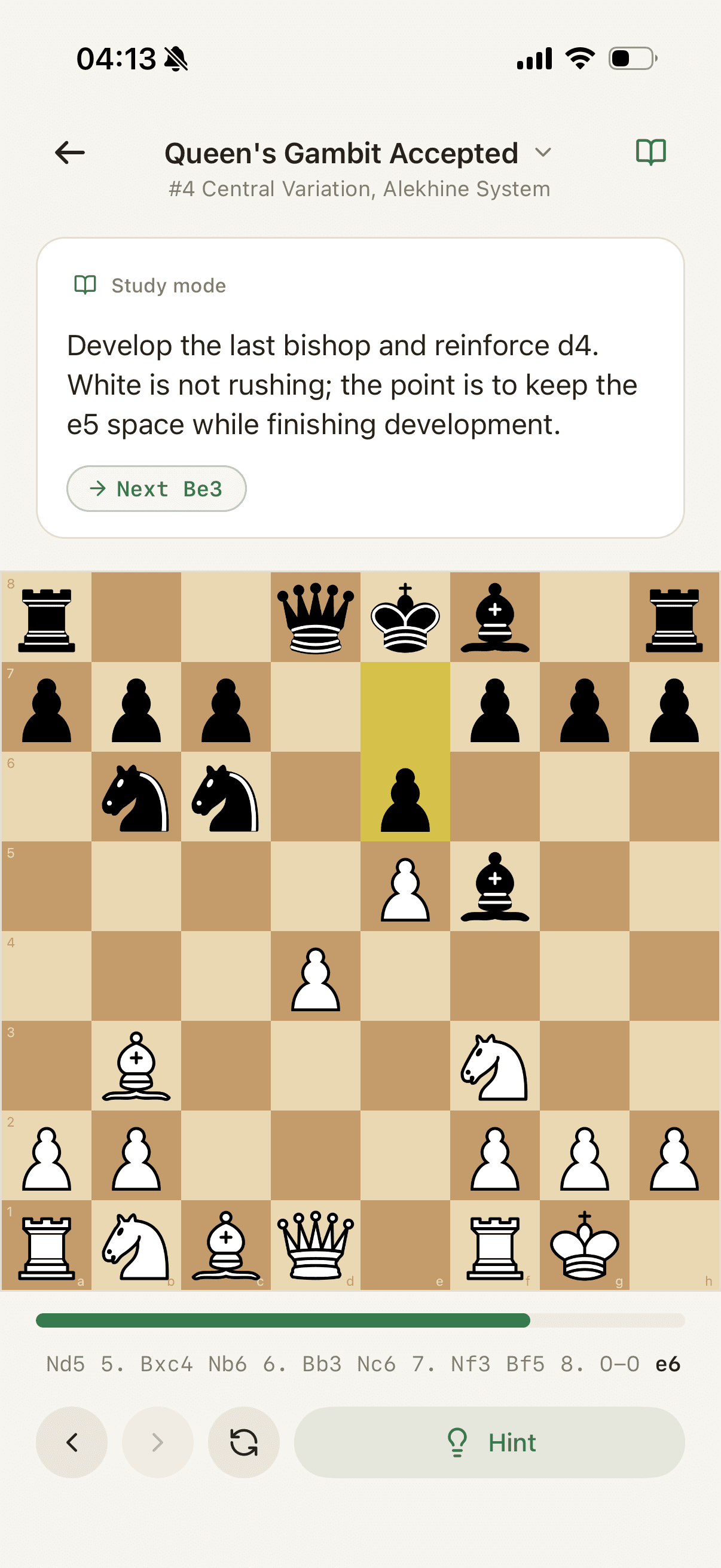
A useful first opening removes some uncertainty from the first moves without creating a second job maintaining theory. Start with the position you want to play and learn its first important branch. Your games will show you what to add next.
Master openings.
Learn curated lines, recall the move from the board, and keep useful positions fresh with spaced review.