
Queen's Gambit for beginners: plans before theory
Learn what 2.c4 asks, how the Accepted and Declined structures differ, and which Queen's Gambit branch a beginner should train first.
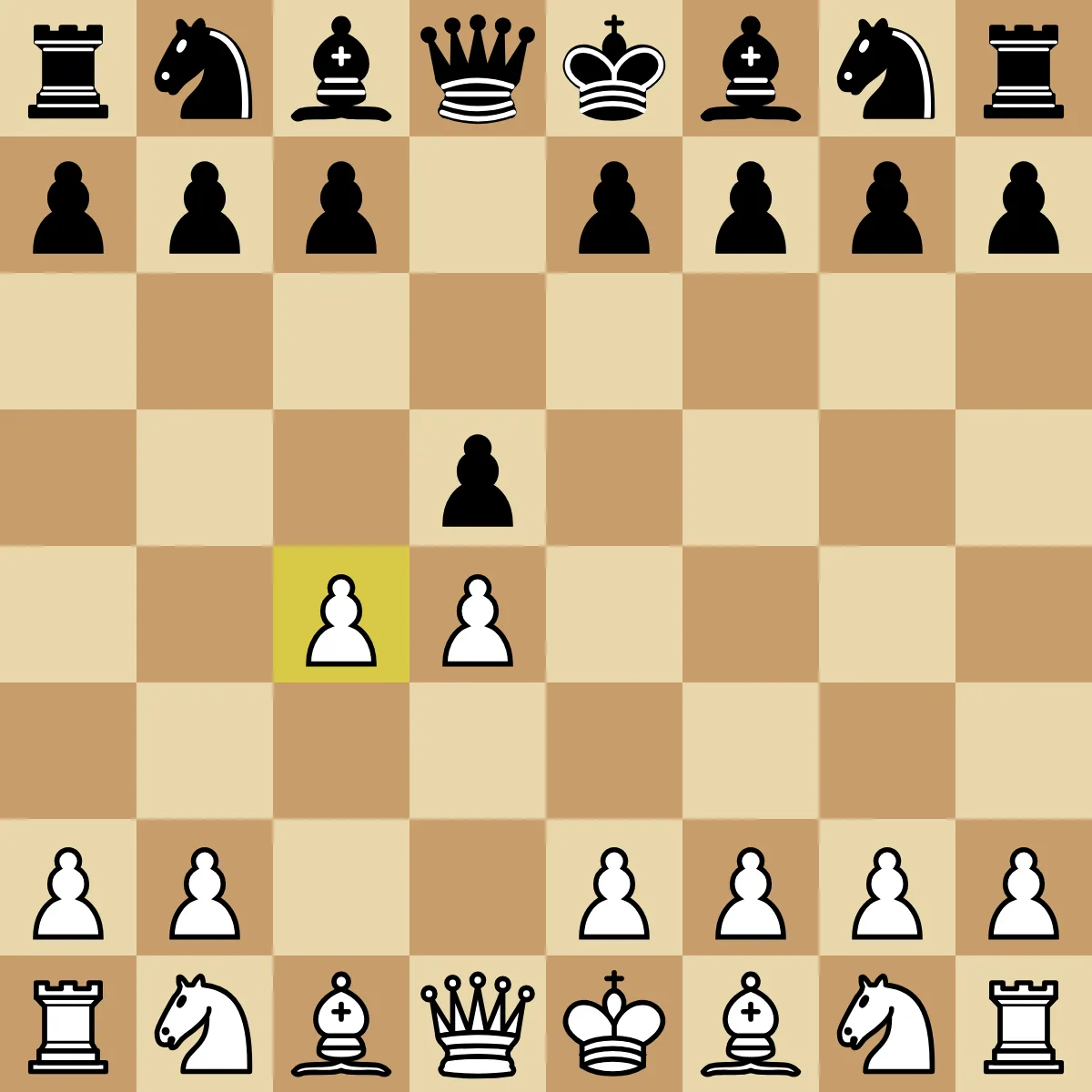
The Queen's Gambit begins after 1.d4 d5 2.c4.
The Queen's Gambit begins with 1.d4 d5 2.c4. White challenges Black's pawn on d5 and asks a concrete question before developing the pieces: will Black capture on c4, defend d5, or support the center another way?
A beginner does not need the whole answer tree. The first useful task is to separate the Queen's Gambit Accepted after 2...dxc4 from the Queen's Gambit Declined after 2...e6. One gives White extra central space and a pawn to recover. The other keeps the d5 pawn in place and builds a slower fight around it.
Learn those structures as two different board problems. Black's second move should tell you which plan to recall.
What White is doing with 2.c4
White plays c4 to challenge the pawn that supports Black's share of the center. If Black exchanges on c4, the d5 pawn leaves the center. If Black defends d5, White gains a stable target and continues development around the pressure.
The word "gambit" can make the opening sound like a quick attack based on sacrificing material. The c-pawn is different from many tactical gambits. Black can take it, but holding it safely may cost time and allow White to build a broad center.
White should connect c4 to central control. Immediate pawn recovery is only one possible next task. That reason remains useful across several variations, even when the next moves differ.
First cue: Black accepts with 2...dxc4
The Queen's Gambit Accepted removes Black's d-pawn from the center. White can use the extra space to play e4 in some lines, develop quickly, and prepare to recover the pawn on c4.
The useful beginner cue is the black pawn on c4. It may look like lost material, but chasing it with the queen too early can waste development. White often builds the center first and recaptures with a bishop after the position is ready.
The Accepted branch teaches three connected decisions:
- whether White can build with
e4 - how White develops the light-squared bishop toward c4
- when recovering the pawn helps rather than interrupts development
Train one line until the pawn on c4 prompts the plan. The exact recovery move matters less at first than understanding why White can wait.
Second cue: Black declines with 2...e6
The Queen's Gambit Declined keeps the d5 pawn in the center and supports it with e6. Black gains a stable chain but blocks the natural diagonal of the light-squared bishop.
White usually develops with Nc3, Nf3, and often Bg5, adding pressure while preparing a central decision. The position is not won by attacking d5 repeatedly. White must finish development and choose the right time for e4, an exchange on d5, or another structural plan.
The bishop on c8 is a visible part of the Declined structure. Black may prepare ...b6 so the bishop can develop to b7 or a6, or seek a freeing ...c5 or ...e5 break. ...Nbd7 often helps prepare ...e5; it does not solve the bishop problem by itself. White's plan should notice which approach Black chose instead of repeating the same setup automatically.
Accepted and Declined need separate reviews
The two branches share 1.d4 d5 2.c4, but the position changes immediately after Black's reply. Grouping them into one memorized sequence makes it easy to recall a valid Queen's Gambit move in the wrong structure.
After 2...dxc4, ask how White uses the center and recovers the pawn. After 2...e6, ask how White develops pressure against d5 while Black's bishop remains restricted. Those questions are different enough to become separate review prompts.
Start the board at Black's second move during practice. Replaying 1.d4 d5 2.c4 from the beginning every time mostly tests the shared moves. The useful test begins when the branches split.
Learn plans before adding sidelines
The Queen's Gambit family also includes the Slav with 2...c6, the Chigorin with 2...Nc6, and other defenses. Each deserves a response eventually, but none needs to enter the first session merely because it exists in a database.
Add a sideline when it appears in your games or repeatedly leaves you without a plan. Until then, the Accepted and Declined positions teach the central ideas that make the family understandable.
The Queen's Gambit family guide provides the broader map. Use it to identify the branch, then return to the course that matches the position you are training.
A practical first training order
A beginner can learn the Queen's Gambit in five steps:
- Reach
1.d4 d5 2.c4and explain why White challenges d5. - Choose the Accepted or Declined branch based on what appears in your games.
- Learn one line until Black's second move prompts White's plan.
- Add the other main branch as a separate board prompt.
- Record a sideline only after it creates a repeated practical problem.
This order keeps the first repertoire small without pretending Black has only two legal replies. It also gives each added line a reason to occupy future review time.
What to remember when the notation fades
Three board features can reconstruct much of the early plan:
- whether Black's d-pawn remains on d5
- whether a black pawn is waiting on c4
- whether Black's light-squared bishop is still blocked by e6
Those features are stronger cues than the opening name alone. "Queen's Gambit" identifies the family; the pawn placement identifies the problem you must solve now.
Attach one short reason to each course move. e4 may claim the center after Black accepted. Bg5 may increase pressure in the Declined. A reason does not replace concrete calculation, but it gives the move a route back when the sequence is no longer visible.
How Chessmate separates the branches
Disclosure: Chessmate is our product. The same training order can be used with another board-based trainer or a carefully organized study.
Chessmate currently has separate White courses for the Queen's Gambit Accepted and Queen's Gambit Declined. Each course keeps its own lines and returns positions from that structure for review.
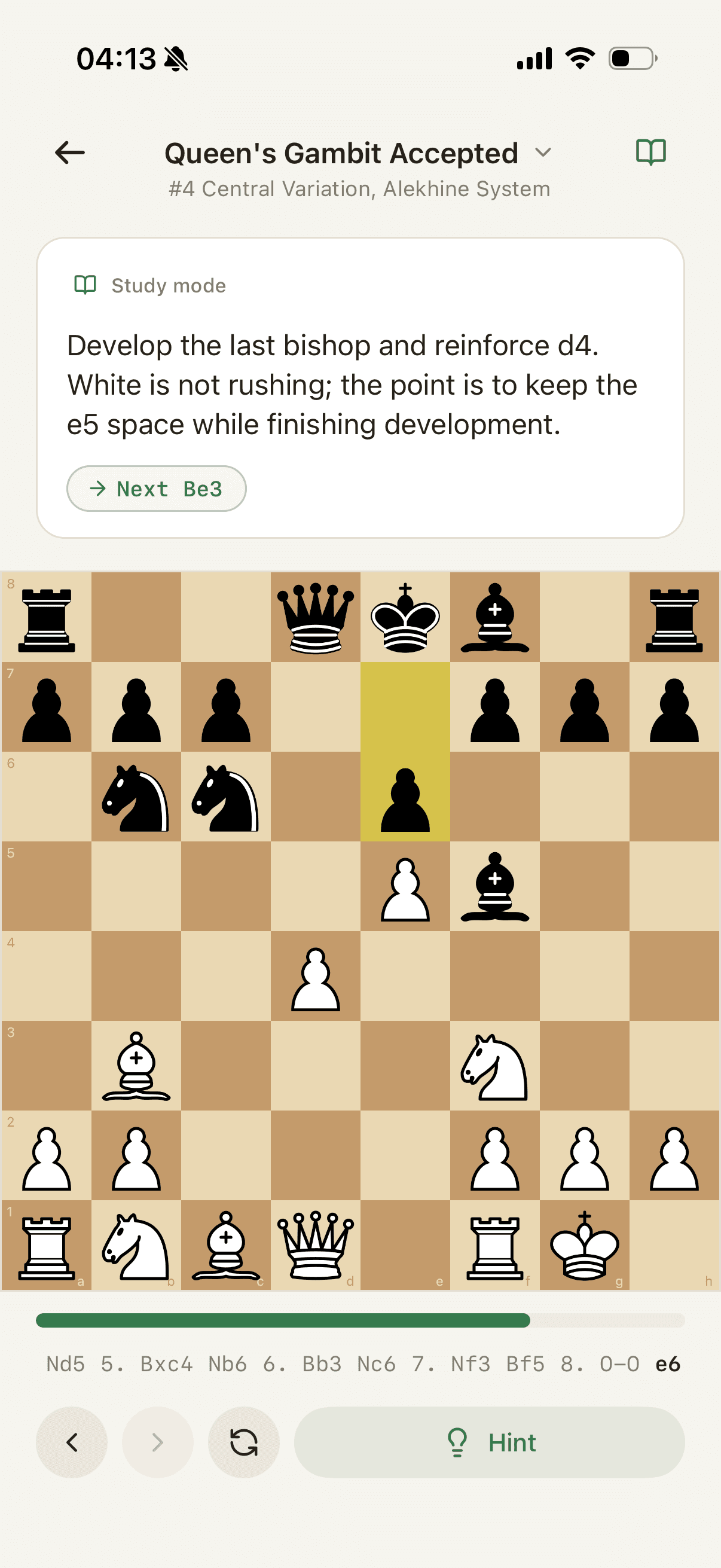
Choose one course first. Study the reason beside the board, play the selected move, and review from Black's last move later. Add the second course when you can explain how its center differs from the first.
The Queen's Gambit becomes manageable when the d5 and c4 pawns organize the repertoire. Recognize whether Black accepted or declined, recall the plan attached to that structure, and let your games decide which branch comes next.
Master openings.
Learn curated lines, recall the move from the board, and keep useful positions fresh with spaced review.


Scan to get the app on your phone